

Key Takeaways
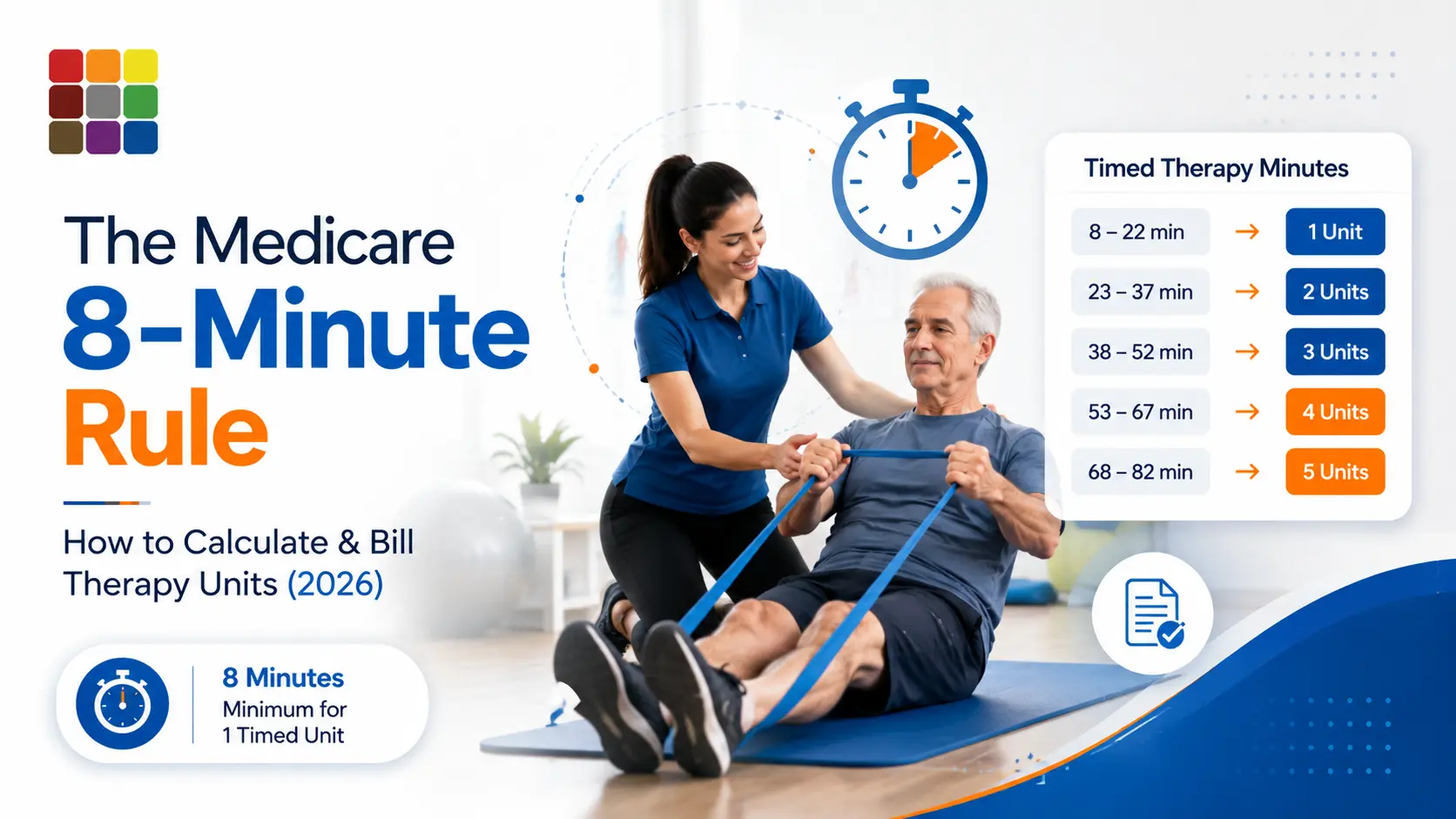
- You must provide at least 8 minutes of direct, one-on-one therapy to bill one unit of a timed CPT code.
- Add all timed minutes, divide by 15, then add one more unit if 8 or more minutes remain (7 or fewer are dropped).
- CMS made no changes to the 8-minute rule for 2026 — the methodology is still defined in the Medicare Claims Processing Manual, Chapter 5.
- Medicare aggregates minutes and allows mixed remainders; the AMA Rule of Eights counts each code separately.
- For 2026, the KX modifier threshold is $2,480 (PT+SLP combined; a separate $2,480 for OT) — distinct from the $3,000 targeted medical-review threshold.
The Medicare 8-minute rule decides how many billable units you can charge for time-based therapy services — and getting it wrong is one of the fastest ways to trigger denials or an audit. This 2026 guide breaks it down for physical therapy, occupational therapy, and speech therapy billing teams: the units chart and calculator method, the step-by-step math, mixed remainders, how it differs from the AMA Rule of Eights, the exceptions, and what stayed the same under CMS this year.
What Is the Medicare 8-Minute Rule?
The Medicare 8-minute rule is a CMS billing methodology that determines how many units of a time-based (timed) CPT code you can bill. You must provide at least 8 minutes of direct, one-on-one therapy to bill one unit. To find total units, add up all timed minutes, divide by 15, and bill an extra unit whenever 8 or more minutes are left over.
In plain terms: each unit of a time-based CPT code represents about 15 minutes of skilled, one-on-one care. Because real treatment rarely lands on tidy 15-minute blocks, the 8-minute rule tells you what to do with the leftover minutes. CMS phased the rule in during 1999–2000 to standardize outpatient therapy billing and stop providers from rounding up, and it applies to outpatient therapy billed under Medicare Part B across PT, OT, and SLP — so every biller and clinician on your team should know it cold. The good news: once you see the pattern, the math is simple, and modern physical therapy billing software can calculate it for you automatically.
↑ 53 timed minutes → 3 base units + an 8-minute remainder → 4 billable units.
The 8-Minute Rule Chart (Minutes to Units)
This is the reference every billing team keeps handy — an 8 minute rule cheat sheet that already builds in the remainder logic, so you can convert total timed minutes straight into billable units:
| Total timed minutes | Billable units |
|---|---|
| 8 – 22 minutes | 1 unit |
| 23 – 37 minutes | 2 units |
| 38 – 52 minutes | 3 units |
| 53 – 67 minutes | 4 units |
| 68 – 82 minutes | 5 units |
| 83 – 97 minutes | 6 units |
| 98 – 112 minutes | 7 units |
| 113 – 127 minutes | 8 units |
Tip: add 15 minutes for each additional unit beyond this range.
Save this: a printable 8 minute rule chart at the front desk cuts unit-calculation errors fast — or let your EMR apply it automatically as you document.
Two Ways to Do the 8-Minute Rule Math (No Chart Needed)
There are two quick ways to calculate units without the chart. The long-division method: divide total timed minutes by 15 and add a unit if the remainder is 8 or more. The start-at-8 method: each new unit "opens" at 8, 23, 38, 53, 68… (that's 8 plus multiples of 15). Both give the same 8-minute rule answer.
Method 1 — Long division
Take your total timed minutes and divide by 15. The whole number is your base units; the leftover is your remainder. If the remainder is 8 or more, add one unit — if it's 7 or fewer, drop it. Example: 23 ÷ 15 = 1 with a remainder of 8, so you can bill 2 units. (Heads up: a standard calculator won't show the remainder, which is where a built-in 8-minute rule calculator inside your EMR saves time.)
Method 2 — Start at 8
Instead of dividing, memorize where each unit begins. One unit starts at 8 minutes; every unit after that opens 15 minutes later — 23, 38, 53, 68, 83, and so on. So if a visit has 50 timed minutes, you haven't hit 53 yet, meaning you're still at 3 units. This is the fastest mental shortcut once the pattern clicks.
How to Calculate Billing Units: Step by Step
To calculate physical therapy billing units under the 8-minute rule: (1) add up every timed CPT code minute for the visit, (2) divide the total by 15 to get your base units, (3) if 8 or more minutes remain, add one unit; if 7 or fewer remain, drop them, then (4) add any untimed, service-based units separately.
- Total your timed minutes. Add the direct, one-on-one minutes across all your time-based codes (e.g., 97110, 97112, 97140, 97530). Leave out untimed, service-based codes.
- Divide by 15. The whole number is your base number of PT billing units.
- Check the remainder. 8+ leftover minutes earns one more unit; 7 or fewer is dropped.
- Assign each unit to a code. When leftovers come from more than one service, use the mixed-remainder rule below.
- Add untimed units. Bill each service-based (untimed) code once, then add those to your timed units for the total on that date of service.
Total Direct Minutes vs. Total Treatment Minutes
Total Direct Minutes are the minutes spent on timed, one-on-one CPT codes — the number you run through the 8-minute rule. Total Treatment Minutes are all minutes of care, including untimed, service-based codes. Only Total Direct Minutes drive your timed-unit count; Total Treatment Minutes are documented for the record.
The distinction matters because a common billing error is running Total Treatment Minutes through the 8-minute rule and inflating units. Keep them separate: divide only the direct (timed) minutes by 15, then add your untimed units on top. Clear therapy documentation that records both numbers — with start/stop times — is what makes the math defensible in an audit.
Quick Answers: How Many Units Is 30, 33, 45, 60 or 72 Minutes?
Under the Medicare 8-minute rule: 30 timed minutes = 2 units, 33 minutes = 2 units, 45 minutes = 3 units, 60 minutes = 4 units, and 72 minutes = 5 units. These assume all minutes come from timed, one-on-one CPT codes and exclude untimed services like evaluations or hot/cold packs.
| Timed minutes | Billable units | Why |
|---|---|---|
| 15 minutes | 1 unit | Falls in the 8–22 band |
| 30 minutes | 2 units | 30 ÷ 15 = 2, no remainder |
| 33 minutes | 2 units | 2 units + 3-min remainder (<8) → drop |
| 45 minutes | 3 units | 45 ÷ 15 = 3, no remainder |
| 53 minutes | 4 units | 3 units + 8-min remainder → +1 |
| 60 minutes | 4 units | 60 ÷ 15 = 4, no remainder |
| 72 minutes | 5 units | 4 units + 12-min remainder → +1 |
Timed vs. Untimed CPT Codes (PT, OT & SLP)
Timed (constant-attendance) CPT codes are billed in 15-minute units under the 8-minute rule. Untimed (service-based) codes — like evaluations and hot/cold packs — are billed once per session regardless of time.
The 8-minute rule only applies to timed codes. Knowing which of your physical therapy CPT codes, occupational therapy CPT codes, and speech therapy CPT codes are timed vs untimed is the foundation of clean billing. A few catch people out: ultrasound (97035), iontophoresis (97033), and attended electrical stimulation (97032) are timed, while unattended e-stim (97014 / G0283 for Medicare) and hot/cold packs (97010) are untimed.
| Type | Examples | How to bill |
|---|---|---|
| Timed — PT/OT | 97110 therapeutic exercise, 97112 neuromuscular re-ed, 97116 gait training, 97140 manual therapy, 97530 therapeutic activities, 97535 self-care/ADL training, 97035 ultrasound, 97033 iontophoresis, 97032 attended e-stim | 15-minute units via the 8-minute rule |
| Timed — SLP | 97129/97130 cognitive intervention; 92607/92608 AAC evaluation | 15-minute units (per code rules) |
| Untimed — evals | PT 97161-97163, OT 97165-97167, SLP 92521-92524 | One unit per evaluation, regardless of time |
| Untimed — SLP treatment | 92507 individual treatment, 92526 dysphagia therapy | One unit per session |
| Untimed — modalities | 97010 hot/cold packs, 97012 mechanical traction, 97014 unattended e-stim | Service-based; not counted in the 8-minute math |
Always confirm current CPT descriptors and payer rules — code classifications can change annually.
Worked Example: 50 vs. 53 Timed Minutes
The clearest way to see the rule is a side-by-side. Same visit, just 3 more minutes of ultrasound — and it changes the bill by a full unit:
The takeaway: three extra minutes of ultrasound pushed the remainder to 8, earning a fourth billable unit. That's real, compliant revenue you'd lose if you tracked time loosely — and exactly why accurate clinical documentation with start/stop times matters.
Mixed Remainders and the Largest-Remainder Rule
Mixed remainders happen when leftover minutes come from more than one timed code. If those leftovers add up to 8 or more, Medicare lets you bill one extra unit — assigned to the service with the greatest remaining time. Note: many commercial payers using the Rule of Eights do not allow this.
Here's a full session at 57 total timed minutes. From the chart, 57 minutes allows 4 units. First give each code its whole 15-minute units, then hand any leftover units to the largest remainders:
Step 1 — base units from full 15-minute blocks
| Code | Minutes | Full units | Remainder |
|---|---|---|---|
| 97110 | 18 min | 1 | 3 min |
| 97140 | 20 min | 1 | 5 min |
| 97112 | 10 min | 0 | 10 min ← largest |
| 97530 | 9 min | 0 | 9 min |
Step 2 — assign the leftover units by largest remainder
Base units so far = 2. Total allowed = 4, so 2 units remain. They go to the two biggest remainders — 97112 (10 min) and 97530 (9 min):
| Code | Final units |
|---|---|
| 97110 | 1 unit |
| 97140 | 1 unit |
| 97112 | 1 unit |
| 97530 | 1 unit |
Common mistake to avoid: a code with only 10 leftover minutes can earn at most one unit — you can't bill 2 units for 10 minutes of work. The extra unit goes to the largest remainder, not to the highest-paying code and not doubled onto one service. Billing more units than the minutes support is a classic audit trigger.
Does Assessment & Management Time Count Toward the 8-Minute Rule?
Yes — within limits. Time-based CPT codes include the assessment and management that's part of delivering a skilled, timed intervention: assessing the patient before treatment, gauging their response during it, giving self-care instruction, answering questions, and documenting in the patient's presence. That time counts toward the timed total only when it directly supports the intervention and is captured in your documentation.
This is one of the most under-counted areas in therapy billing — teams often log only "hands-on" minutes and leave earned, compliant time on the table. The key word is defensible: your note must clearly tie the assessment and management minutes to the skilled service, describe the clinical reasoning, and be understandable to another reviewer. Pure administrative charting done after the patient leaves does not count. When in doubt, document the "why," not just the "what" — that's what protects the minutes if a payer asks.
The 8-Minute Rule vs. the AMA "Rule of Eights"
Medicare's 8-minute rule aggregates all timed minutes before calculating units and allows mixed remainders. The AMA Rule of Eights — sometimes called the Substantial Portion Methodology or "midpoint rule," used by many commercial payers — evaluates each timed code separately and does not allow mixed remainders, so the same session can produce a different unit count.
Not every payer counts minutes the same way, and the difference cuts both directions — sometimes the Rule of Eights yields more units, sometimes fewer:
| Session | Medicare 8-minute rule | AMA Rule of Eights |
|---|---|---|
| 97110 — 10 min 97116 — 10 min | 20 ÷ 15 = 1 unit + 5 min remainder → 1 unit | Each code ≥ 8 min → 2 units (AMA yields more) |
| 97110 — 6 min 97140 — 6 min 97112 — 6 min | 18 ÷ 15 = 1 unit → 1 unit (Medicare yields more) | Each code < 8 min → 0 units |
Same visit, different unit counts. Always confirm which methodology a payer uses before you bill — this is one of the most expensive assumptions in therapy billing. Note the Rule of Eights applies only to timed codes whose "usual time" is defined as 15 minutes.
Does the 8-Minute Rule Apply to OT and SLP?
Yes. The 8-minute rule applies to all outpatient rehab disciplines — physical therapy, occupational therapy, and speech-language pathology — for time-based CPT codes billed under Medicare Part B.
For occupational therapy billing, timed codes such as 97530 (therapeutic activities) and 97535 (self-care/ADL training) follow the same 15-minute math, with the GO modifier on Medicare lines — so 30 timed OT minutes = 2 units, exactly like PT. For speech therapy billing, most core codes — 92507 (treatment) and 92526 (dysphagia) — are untimed, billed once per session, so the 8-minute rule usually doesn't apply; timed SLP codes like 97129/97130 do (a 72-minute cognitive-intervention session = 5 units). The rule also applies in pediatric therapy for PT, OT, and SLP services billed to Medicaid and many payers.
Exceptions to the 8-Minute Rule
The 8-minute rule does not apply to untimed, service-based codes, to group therapy (97150), or to services billed under methodologies other than Medicare's. Some payers also use different rules entirely — the AMA Rule of Eights, or state-specific variations like partial-unit, 5-minute-threshold, or no-rounding rules — and certain telehealth services may follow separate guidance.
Before you assume the standard 8-minute math applies, check for these exceptions:
- Service-based (untimed) codes — evaluations, hot/cold packs, traction, and unattended e-stim are billed once, never run through the 8-minute rule.
- Group therapy (97150) — billed per the group-therapy rules, not the timed 8-minute methodology.
- Rule-of-Eights payers — many commercial plans calculate each code separately and disallow mixed remainders.
- State / payer-specific variations — some Medicaid programs use partial-unit rules, 5-minute thresholds, or no-rounding policies.
- Telehealth — some virtual services follow separate billing guidance; confirm case-by-case, as rules here have changed.
Rule of thumb: when a federal payer (Medicare, Medicaid, TRICARE) is primary — or even secondary or tertiary — defaulting to the 8-minute rule is usually the safe, compliant choice unless the payer's manual says otherwise.
Which Payers Use the 8-Minute Rule?
The 8-minute rule is a Medicare standard, and it's also followed by Medicaid, TRICARE, and many commercial insurers. But some commercial payers use the AMA Rule of Eights instead — and most of those don't allow mixed remainders. Before you submit:
- Confirm each payer's methodology (8-minute rule vs Rule of Eights) in their provider manual
- Check whether mixed remainders are permitted
- Watch for state-specific Medicaid variations (partial-unit, 5-minute, or no-rounding rules)
- Verify the patient's benefits and any authorization limits before the visit
What Changed for the 8-Minute Rule in 2026?
CMS made no changes to the 8-minute rule or its unit thresholds for 2026 — the methodology is unchanged and still defined in the Medicare Claims Processing Manual, Chapter 5. What shifted around it: the 2026 KX modifier threshold is $2,480 (PT+SLP combined; a separate $2,480 for OT), the targeted medical-review threshold stays at $3,000, and the Medicare Part B deductible is $283.
Even though the core math is the same, the compliance environment keeps tightening. Details worth flagging for your 2026 billing team:
- KX modifier threshold: $2,480. Once a patient's cumulative therapy spend passes this amount, you attach the KX modifier and your documentation must justify continued medical necessity — so your timed-unit math has to be airtight.
- Targeted medical-review threshold: $3,000. This is separate from — and higher than — the KX threshold, and remains $3,000 through 2028. Many articles conflate the two; they're different numbers doing different jobs.
- Part B deductible: $283. Medicare pays 80% of the approved amount after the deductible is met (patient pays 20%).
- The hard therapy cap is gone. The Bipartisan Budget Act of 2018 permanently repealed the old dollar cap; the threshold-plus-KX system replaced it.
- MPPR still applies. The Multiple Procedure Payment Reduction continues to reduce the practice-expense component of subsequent same-day timed services.
Bottom line: the rule didn't change, but scrutiny did. Accurate start/stop times and unit math are your best 2026 audit defense.
Common 8-Minute Rule Mistakes & Audit Triggers
CMS and Medicare Administrative Contractors actively flag time-based billing patterns. Avoid these physical therapy billing errors that lead to denials or a CERT audit:
- Always landing on the threshold — consistently billing exactly 23, 38, or 53 minutes looks like rounding up
- Units that don't match documented time — your note must support the minutes billed
- Counting untimed codes in the timed total (hot packs, traction, evaluations don't count)
- Running Total Treatment Minutes through the rule instead of Total Direct Minutes
- Overbilling a single code — more units than its minutes support (see the mixed-remainder warning above)
- Assuming every payer follows Medicare — Rule-of-Eights plans calculate differently
- Padding time — deliberately stretching a visit to reach the next unit is a compliance risk
- KX modifier overuse — applying it without contemporaneous medical-necessity justification draws review
- Weak documentation — defensible therapy documentation with start/stop times protects every unit
The easy button
The Best Physical Therapy Billing Software for the 8-Minute Rule
Practice Pro is a strong choice for clinics that want the 8-minute rule handled automatically. It totals timed minutes, applies the 8-minute rule and mixed-remainder logic in real time, separates direct from treatment minutes, and flags units your documentation doesn't support — so you capture every earned unit and stay audit-ready.
Manual unit math is slow and error-prone. Practice Pro connects the note directly to the claim, so charges are captured accurately and go out clean the first time. Because it's purpose-built for PT, OT, and SLP — not a generic medical EHR, and not a billing product bolted onto a separate EMR — the minutes you document flow straight into compliant units. It's built for clinics that want one connected platform instead of five disconnected tools:
Frequently Asked Questions
Sources & References
- Centers for Medicare & Medicaid Services (CMS), Medicare Claims Processing Manual, Chapter 5 — therapy services and time-based coding methodology.
- CMS, Therapy Services — CY 2026 KX modifier threshold ($2,480 for PT/SLP combined and $2,480 for OT) and the $3,000 targeted medical-review threshold (Transmittal R13437CP / CR 14252).
- CMS — 2026 Medicare Part B deductible ($283) and 20% coinsurance; Multiple Procedure Payment Reduction (MPPR) guidance.
- Bipartisan Budget Act of 2018 — permanent repeal of the outpatient therapy hard cap and creation of the KX threshold process.
- American Medical Association (AMA) CPT® coding guidance — the "Rule of Eights" / Substantial Portion Methodology used by many commercial payers.
Disclaimer: This guide is for educational purposes and reflects our understanding of CMS and AMA guidance as of August 2026. Coding, thresholds, and payer policies change; always verify current CPT® descriptors and each payer's provider manual before billing. This is not legal, coding, or reimbursement advice.