

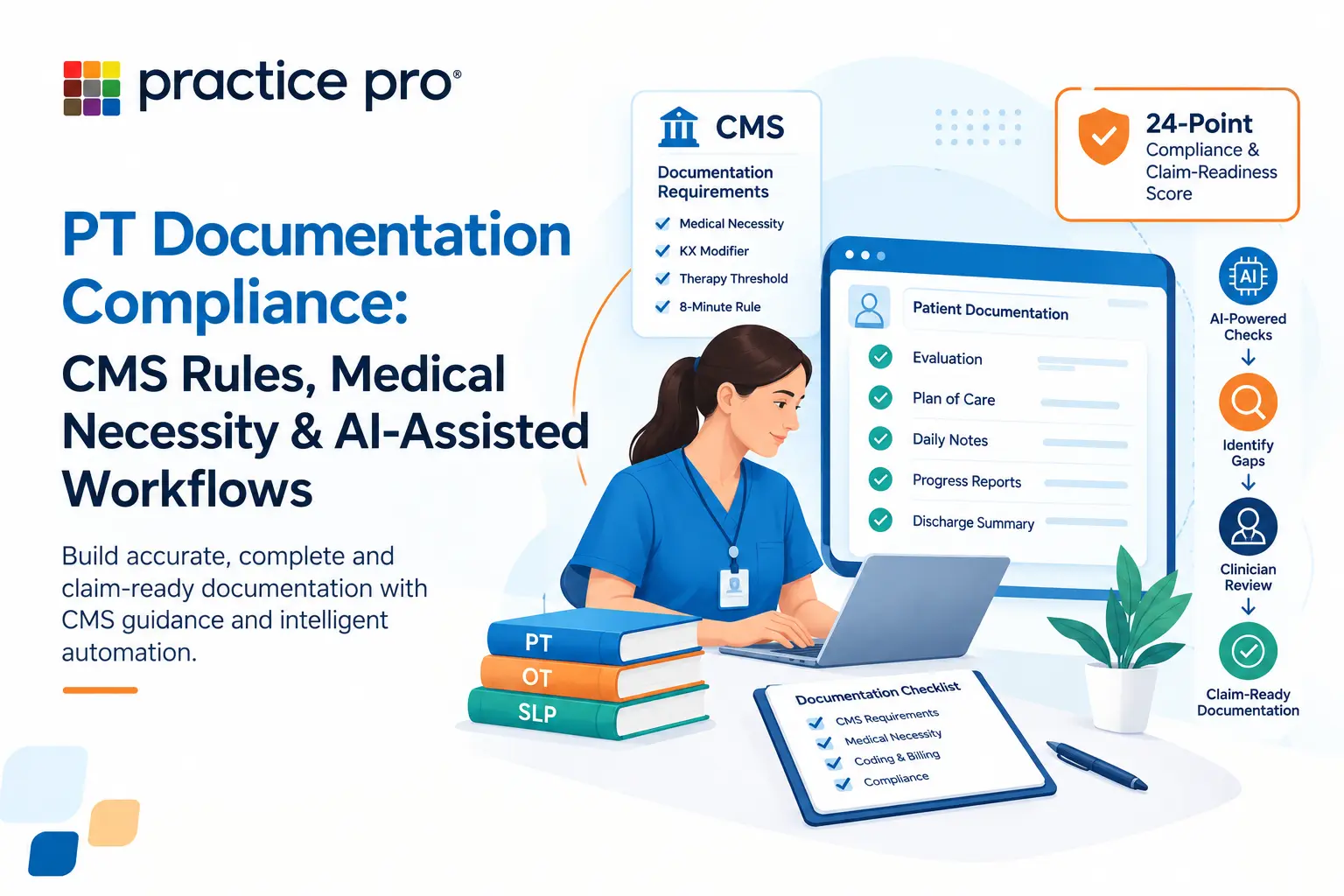
How we verified this guide: the regulatory requirements below are drawn from primary CMS sources — the Medicare Benefit Policy Manual (Pub. 100-02, Ch. 15), the Medicare Claims Processing Manual (Pub. 100-04, Ch. 5), CMS fact sheet MLN905365 (September 2025), and the CMS Therapy Services page — and reflect requirements in effect for calendar year 2026. Rules change; always confirm against current CMS guidance and your MAC/payer policy. Full links in sources & references.
PT Documentation Compliance — Key Points
- Medicare Part B pays for outpatient PT only when a physician/NPP-certified plan of care, medical necessity, and complete documentation all line up.
- The core documents are the evaluation, plan of care, treatment (daily) notes, progress reports, and discharge summary.
- Progress reports are due at least every 10 treatment days; the plan of care must be certified within 30 days and recertified at least every 90 days.
- For 2026, the KX modifier threshold is $2,480 (PT and SLP combined) and the targeted medical-review threshold is $3,000.
- AI-assisted checks can surface potential gaps before billing, but the clinician always reviews and signs — automation supports, it doesn't decide.
Physical therapy documentation compliance is where good care and getting paid meet. Medicare doesn't reimburse the treatment you delivered — it reimburses the treatment you can demonstrate was reasonable, necessary, and skilled. This guide walks through exactly what CMS expects in outpatient Part B therapy records, where claims most often fall short, and how clinics review documentation before it becomes a claim — including where AI-assisted checks genuinely help and where clinical judgment stays in charge.
What Is Physical Therapy Documentation Compliance?
Physical therapy documentation compliance is the practice of creating therapy records that meet Medicare and payer requirements, support the medical necessity of skilled care, and substantiate every billed service. In short, the documentation must justify that the service was reasonable, necessary, skilled, and actually delivered — before it becomes a claim.
Compliance isn't one form; it's a chain. It starts with an evaluation that establishes why skilled therapy is needed, continues through a certified plan of care and daily notes that record what was done, and is confirmed by progress reports that show whether the patient is improving. Three ideas run through all of it: completeness (the required elements are present), medical necessity (the record shows why a skilled therapist was required), and claim readiness (the documentation supports the codes and units billed). And because a licensed clinician authored and signed the note, the responsibility for what it says stays with the clinician — software can assist, but it cannot certify the record for you.
What Does CMS Require in Physical Therapy Documentation?
CMS requires that outpatient Part B therapy be furnished under a physician/NPP-certified plan of care, be reasonable and necessary, and be supported by documentation that includes an evaluation, plan of care, treatment (daily) notes, periodic progress reports, and a discharge summary. Each document has a specific job in demonstrating skilled, medically necessary care.
The requirements live in the Medicare Benefit Policy Manual, Chapter 15, and CMS summarizes them in fact sheet MLN905365. Here's what each core document should establish.
1. Physical Therapy Evaluation
The evaluation is the foundation. It documents the patient's condition, objective baseline measurements, relevant history, and the clinical reasoning that establishes why skilled therapy is medically necessary. A strong evaluation names the functional limitations to be addressed and sets measurable, time-bound goals that the rest of the record will track against.
2. Plan of Care
The plan of care (POC) must contain, at a minimum, the patient's diagnoses, long-term treatment goals, and the type, amount, duration, and frequency of therapy services. It must be established before treatment (by a physician, NPP, or the qualified therapist providing the services) and certified by a physician or NPP. The POC is the document a reviewer compares everything else against, so vague frequency ("as needed") or missing goals undermine the whole record.
3. Treatment / Daily Notes
A treatment note is created for every treatment day. It records the date of service, each specific intervention or modality provided, the total timed-code treatment minutes and total treatment time, and the signature and professional identification of the qualified provider. Daily notes don't have to justify medical necessity on their own, but they must show what was actually done — and they must support the codes and units on the claim.
4. Progress Reports
The progress report is where medical necessity is re-justified over time. A clinician (not a PTA) must complete one at least once every 10 treatment days. It summarizes progress toward goals, the patient's response to treatment, and the continued need for skilled services — including any plan revisions. Missing or incomplete progress reports are among the most common therapy documentation errors CMS cites.
5. Discharge Documentation
The discharge note (a discharge progress report) closes the episode. It summarizes the care provided, the patient's status relative to the goals set at evaluation, and the reason for discharge. It should tie the beginning of the episode to the end, showing the arc of skilled care.
| Document | What it should establish | Why it matters |
|---|---|---|
| Evaluation | Condition, objective baseline, diagnosis/prognosis, functional limitations, why skilled therapy is needed, measurable goals | Establishes medical necessity at the start of care |
| Plan of Care | Diagnoses; long-term goals; type, amount, duration & frequency of services | The certified blueprint every other document is measured against |
| Treatment / Daily Note | Date, specific interventions, timed-code minutes & total treatment time, provider signature | Shows what was delivered and supports billed codes/units |
| Progress Report (≥ every 10 treatment days) | Progress toward goals, response to care, continued need for skilled services | Re-justifies medical necessity over the episode |
| Discharge Summary | Care provided, status vs. goals, reason for discharge | Closes the episode and demonstrates outcomes |
Source: Medicare Benefit Policy Manual, Ch. 15, §§220–230; CMS MLN905365.
Certification and Recertification Requirements
CMS requires the plan of care to be certified by a physician or NPP within 30 calendar days of the initial therapy treatment, and recertified at least every 90 days. Certification confirms the patient needs skilled therapy under a physician's/NPP's care; recertification confirms continued need as care extends.
It helps to keep four related items distinct:
- Physician/NPP order or referral — the referral for therapy. Since January 1, 2025, a signed, dated order or referral can substitute for the physician/NPP signature on the initial plan-of-care certification, provided the POC is transmitted to the referring provider (a one-time transmission within 30 days of initial treatment).
- Plan of care — the document describing the diagnoses, goals, and the type/amount/duration/frequency of services.
- Certification — the physician/NPP attestation of the initial POC, due within 30 days of the first treatment under that plan.
- Recertification — physician/NPP sign-off on continued need, required at intervals not exceeding 90 days.
CMS accepts delayed certifications (with a reason) for a period after they're due, but a delayed signature is a risk, not a routine — build certification tracking into your workflow so plans are certified on time. The 2025 order/referral substitution is summarized in MLN905365 (Sept 2025).
Industry educators such as Gawenda Seminars publish helpful plain-language interpretations of certification, recertification, and frequency-and-duration documentation; use them for education, and rely on CMS for the binding rule.
Medical Necessity in Physical Therapy Documentation
In documentation, medical necessity means the record shows that the therapy required the skills of a qualified therapist, addressed a real functional limitation, followed a reasonable plan, and produced (or reasonably expected) meaningful improvement. It's the thread connecting the diagnosis, the plan, the treatment, and the progress.
Reviewers look for a coherent story, not isolated data points. The elements that build it:
- Diagnosis and functional limitations — what's wrong and how it limits the patient's function.
- Skilled therapy rationale — why a licensed therapist (not an aide or a home program alone) is required.
- Treatment rationale — why the chosen interventions fit the impairments.
- Measurable goals — objective, time-bound targets that make progress verifiable.
- Documented progress — evidence the patient is moving toward those goals, or clear reasoning for plan changes when they aren't.
- Continued need — why skilled services remain necessary at each stage.
CMS describes reasonable-and-necessary outpatient therapy in the Medicare Benefit Policy Manual, Ch. 15 (§220.2). The practical test: could a reviewer, reading only the record, understand why skilled therapy was justified? If the connection between assessment, plan, and treatment isn't visible on the page, medical necessity isn't established — regardless of how appropriate the care actually was.
Common Physical Therapy Documentation Gaps
The most common documentation gaps aren't clinical failures — they're record-keeping gaps: missing frequency/duration, incomplete plans of care, thin medical-necessity justification, absent progress reports, and documentation that doesn't match the codes billed. Each is avoidable with a review step before billing.
| Documentation gap | What's usually missing |
|---|---|
| Frequency & duration not specified | POC omits how often / how long, or uses vague terms |
| Incomplete plan of care | Missing diagnoses, long-term goals, or service parameters |
| Weak medical-necessity justification | No clear link between impairment, skilled need, and goals |
| Missing or late progress reports | No clinician progress report within the 10-treatment-day window |
| Certification/recertification gaps | POC not certified within 30 days, or recert past 90 days |
| Documentation–coding mismatch | Notes don't support the CPT codes, units, or diagnosis billed |
| Incomplete treatment details | Missing timed minutes, total treatment time, or signature |
| Documentation doesn't support billed services | Units billed exceed what the recorded minutes justify |
These reflect commonly cited therapy documentation and workflow risks (see CMS CERT error themes in MLN905365); treat them as a review checklist, not an exhaustive audit standard.
How Medicare Therapy Thresholds and the KX Modifier Relate to Documentation
Once a beneficiary's outpatient therapy expenses pass the annual KX modifier threshold — $2,480 for PT and SLP combined in 2026 (and $2,480 for OT) — you must append the KX modifier to attest the services are medically necessary and supported by documentation. Above the $3,000 targeted medical-review threshold, claims may be selected for review, so documentation carries even more weight.
The KX modifier isn't a billing formality — it's an attestation. By appending it, the provider affirms that the services above the threshold are reasonable and necessary and that the medical record backs that up. Claims that exceed the KX threshold without the modifier are denied, per the CMS Therapy Services page and Transmittal R13437CP (CR 14252).
| 2026 threshold | Amount | What it triggers |
|---|---|---|
| KX modifier threshold — PT & SLP combined | $2,480 | Append KX + document medical necessity to continue |
| KX modifier threshold — OT | $2,480 | Append KX + document medical necessity to continue |
| Targeted medical-review threshold | $3,000 | Claims may be selected for targeted review (held at $3,000 through CY 2027) |
The takeaway for documentation: the thresholds don't cap care, but they raise the bar on proof. As a patient approaches and passes them, the strength of your medical-necessity documentation is what protects the claim. For the mechanics of thresholds and billing, see our Medicare 8-minute rule guide. (This section is a summary — thresholds aren't the focus of this article.)
What Is the 8-Minute Rule and How Does Documentation Support It?
The 8-minute rule is the Medicare method for converting timed, one-on-one treatment minutes into billable units: you need at least 8 minutes of a timed service to bill one unit. Documentation supports it by recording the specific timed minutes and total treatment time, so the units on the claim are backed by the minutes in the note.
The connection is direct: timed minutes drive units, and units drive the claim — but only the documented minutes are defensible. If a note doesn't record start/stop or total timed minutes, the units aren't supported. For the full chart, worked examples, and an interactive calculator, see the Medicare 8-minute rule guide; the rule itself is defined in the Medicare Claims Processing Manual, Ch. 5. We'll keep this brief here to avoid duplicating that resource.
Manual Documentation Review vs. AI-Assisted Documentation Checks
In a manual workflow, documentation is written, then a person reviews it, finds gaps, sends it back for correction, and only then bills — a slow loop that often catches problems late. In an AI-assisted workflow, automated checks surface potential gaps as documentation is completed, the clinician reviews and resolves them, and the claim goes out cleaner. AI supports the review; it doesn't replace the clinician's judgment.
The difference is when and how consistently gaps are caught:
| Step | Manual review | AI-assisted review |
|---|---|---|
| 1 | Documentation completed | Documentation completed |
| 2 | Manual review (if time allows) | Automated checks surface potential gaps |
| 3 | Gaps identified — sometimes after billing | Gaps flagged for clinician review before billing |
| 4 | Correction | Clinician reviews, corrects, and signs |
| 5 | Billing | Billing |
AI-assisted checks are consistent and fast, which makes them well suited to catching the routine, repeatable gaps (a missing signature, a unit count the minutes don't support, an absent progress report). What they should never do is decide compliance. The clinician remains responsible for the content of the note and the final sign-off — the automation's job is to make sure nothing obvious slips through before a human makes the call.
From CMS Requirement to Claim Readiness (At a Glance)
Every CMS requirement can be traced through a simple path: the rule maps to a documentation element, which maps to a workflow check, which the clinician reviews, which determines claim readiness. Seeing the whole chain makes it obvious where a record breaks down.
| CMS requirement | Documentation element | Workflow check | Clinician review | Claim readiness |
|---|---|---|---|---|
| Skilled, medically necessary care | Evaluation with baseline & goals | Are functional limitations & skilled need documented? | Confirm rationale reflects the patient | Necessity established |
| Physician/NPP-certified POC | Plan of care + certification | Diagnoses, goals, frequency/duration present? Certified ≤30 days? | Verify plan matches care delivered | Plan supports the episode |
| Services actually delivered | Treatment / daily note | Interventions, timed minutes, total time, signature present? | Confirm note reflects the visit | Services substantiated |
| Ongoing medical necessity | Progress report (≤ every 10 tx days) | Progress documented within the window? | Confirm continued skilled need | Necessity re-justified |
| Units match minutes (8-min rule) | Timed minutes in the note | Do billed units match documented minutes? | Reconcile units vs minutes | Codes/units supported |
| Above-threshold services (KX) | Medical-necessity documentation + KX | Is KX applied with support past $2,480? | Confirm continued necessity | Threshold attestation supported |
An original Practice Pro framework for understanding documentation flow. Requirements per CMS Benefit Policy Manual Ch. 15 and Claims Processing Manual Ch. 5.
What Is the Practice Pro 24-Point Compliance & Claim-Readiness Score?
Practice Pro's 24-Point Compliance & Claim-Readiness Score is an internal documentation-readiness framework designed to help clinics identify potential gaps before billing. It evaluates documentation across five categories — Administrative, Clinical, Billing, Coding, and Regulatory — and surfaces section-level findings and correction recommendations for clinician review. It is not a CMS score and does not guarantee compliance or payment.
The five categories reflect the different ways a record has to hold up:
- Administrative — the required identifying and workflow elements are present.
- Clinical — the note supports skilled, medically necessary care.
- Billing — the documentation supports what will be billed.
- Coding — diagnosis and procedure coding align with the documentation.
- Regulatory — CMS/Medicare requirements (certification timing, progress-report cadence, threshold attestation, and similar rules) are addressed here.
The framework produces section-level findings and an overall claim-readiness indicator, with actionable recommendations a clinician can act on before the claim goes out. Crucially, the checks run before billing and always route to a human: the clinician reviews the findings, makes any corrections, and signs off. Practice Pro does not publish the exact 24 criteria, weighting, or scoring logic — but the categories and the review-before-billing model are what the framework is built to deliver.
What it is — and isn't. The 24-Point Compliance & Claim-Readiness Score is a readiness aid, not a compliance guarantee. It helps surface potential issues for a clinician to resolve; it does not certify records, guarantee reimbursement, promise zero denials, or replace your compliance team or a qualified consultant.
How AI Can Help Identify Documentation Gaps
AI can help by scanning documentation for missing or inconsistent elements and surfacing them for clinician review — for example, an absent progress report, a unit count the recorded minutes don't support, or a diagnosis that doesn't align with the coded claim. It flags; the clinician decides.
Practical examples of where automated checks help (always for clinician review, never as a final determination):
- Missing documentation elements — e.g., a treatment note without total treatment time, or a plan of care without frequency/duration.
- Inconsistent information — details that conflict across the evaluation, plan, and notes.
- Coding/documentation alignment — CPT codes or units that the documented minutes or interventions don't clearly support.
- Administrative requirements — signatures, identifiers, and required fields.
- Regulatory checks — certification timing and progress-report cadence.
- Billing-related documentation issues — records that may not support the services queued to bill.
Notice the language throughout: AI helps identify, can surface, supports, and provides automated checks for clinician review. That framing isn't hedging — it's the accurate description of the role. Compliance is a professional judgment; automation makes that judgment faster and more consistent, not automatic.
Documentation → checks → claim-readiness → billing
How Practice Pro Supports Documentation Compliance Workflows
Practice Pro connects AI-assisted documentation, documentation checks, claim-readiness scoring, coding, and billing in one rehab-specific platform — so the note the clinician writes and signs flows into a supported claim, with potential gaps surfaced along the way for review.
Because documentation, coding, and billing live in the same system, information doesn't get re-keyed between disconnected tools, and the compliance checks happen where the work already is:
See how Practice Pro supports AI-assisted clinical documentation and connected billing workflows — book a free demo. You always review and sign every note; the software handles the busywork and surfaces what to check.
Physical Therapy Documentation Compliance Checklist
A quick, practical checklist your team can run before a claim goes out. Adapt it to your MAC and payer requirements.
- Evaluation completed Baseline measures, diagnosis/prognosis, functional limitations, and skilled-need rationale documented.
- Plan of care documented Diagnoses, long-term goals, and type/amount/duration/frequency of services present.
- Frequency and duration specified Concrete, not vague — a reviewer can tell how often and how long.
- Certification addressed POC certified within 30 days; recertification on track (≤ 90 days).
- Treatment details documented Interventions, timed minutes, total treatment time, and signature on each daily note.
- Medical necessity supported The record links impairment, skilled need, goals, and progress.
- Progress documented Clinician progress report within the 10-treatment-day window.
- Diagnosis & coding consistent ICD-10 and CPT codes align with the documentation.
- Units match minutes Billed units are supported by the documented timed minutes (8-minute rule).
- Threshold/KX handled KX applied with medical-necessity support once past the annual threshold.
- Reviewed before billing A final documentation review — human sign-off — before the claim is submitted.
This is an educational checklist, not a substitute for payer-specific requirements or professional/legal advice. Always confirm against your MAC's guidance and current CMS policy.
Frequently Asked Questions
Sources & References
- CMS — Medicare Benefit Policy Manual, Pub. 100-02, Chapter 15 (outpatient therapy: plan of care, certification/recertification, progress reports, medical necessity — §§220–230).
- CMS — Medicare Claims Processing Manual, Pub. 100-04, Chapter 5 (timed vs untimed coding / the 8-minute rule).
- CMS — MLN905365: Complying with Outpatient Rehabilitation Therapy Documentation Requirements (September 2025).
- CMS — Therapy Services (KX modifier and threshold policy).
- CMS — Transmittal R13437CP / CR 14252 (CY 2026 KX modifier threshold $2,480; MR threshold $3,000).
- APTA — Medicare Payment Thresholds for Outpatient Therapy Services (secondary, industry).
- Gawenda Seminars — gawendaseminars.com (secondary, industry education on Medicare therapy documentation).
Disclaimer: This article is for educational reference and reflects our understanding of CMS guidance in effect for calendar year 2026 as of September 2026. It is not legal, coding, or reimbursement advice and does not guarantee coverage or payment. CMS rules, thresholds, and payer policies change; always verify against current CMS manuals and your MAC/payer requirements. Documentation and coding decisions rest with the treating clinician and your compliance team. Where professional judgment is required, consult a qualified clinician, certified coder, or compliance professional.