

Key Takeaways
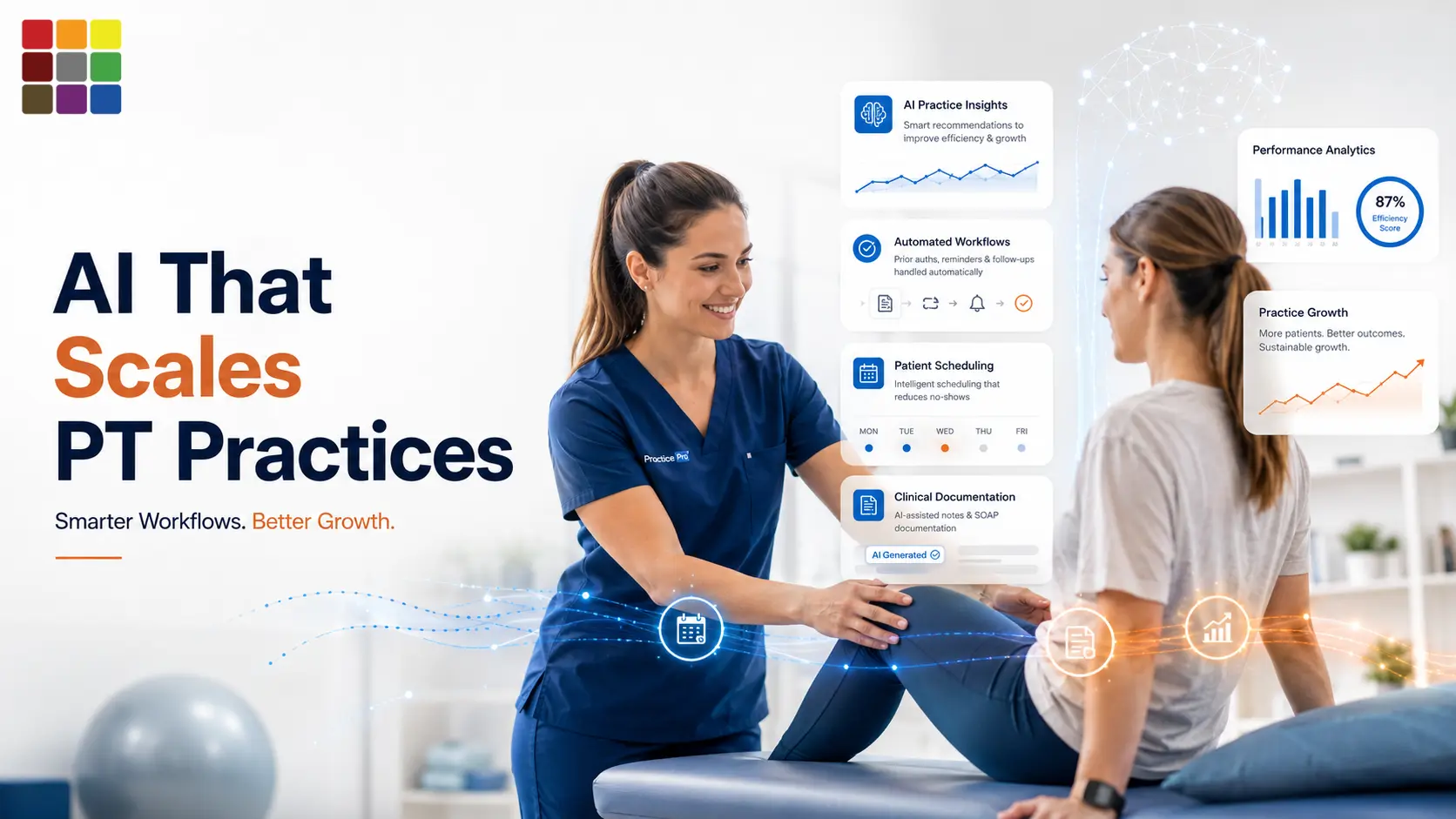
- High-growth PT practices treat AI as an operating model, not an experiment — embedded in documentation, intake, scheduling & billing.
- The four workflows AI touches most: AI documentation, front-desk intake, scheduling, and billing/RCM.
- AI removes operational drag so clinics grow with leaner teams instead of over-hiring.
- A 2026 JAMA study found frequent ambient AI scribe users saved about 27 minutes of documentation time per day (clinician review still required).
- Practice Pro is a connected, AI-powered platform where all four workflows share the same data.
The fastest-growing physical therapy practices in 2026 have stopped asking whether they should use AI. They've already embedded it into how the clinic runs every day — documentation, intake, scheduling, and billing. The result isn't just speed. It's the ability to grow with a leaner team, and the right physical therapy software is what makes that possible.
AI Has Moved From "Nice-to-Have" to Operating Model
High-growth PT practices don't treat AI as a side experiment. They use AI physical therapy software daily across core workflows — cutting admin drag so clinicians can see more patients and focus on care.
The broader trend is unmistakable. One industry analysis found that the share of healthcare organizations using or actively exploring generative AI rose from roughly 72% in early 2024 to about 85% by year-end — an adoption curve rarely seen in clinical settings. The lesson from top practices is simple: AI for physical therapy doesn't replace clinicians. It removes the operational weight around them.
↑ The work still happens — it just stops landing on your team's to-do list.
Where AI Shows Up in High-Growth PT Practices Today
When you look at how top-performing clinics actually use AI physical therapy software, the same four workflows come up again and again. Here's the map:
| Workflow | What AI does | The growth payoff |
|---|---|---|
| Documentation | AI SOAP notes, ambient scribing & CPT coding guidance | Faster notes, more visits per provider |
| Front desk & intake | Digital patient intake & insurance verification | Onboard patients without over-hiring |
| Scheduling | Waitlist automation & no-show prediction | Fuller schedules, less lost revenue |
| Billing & RCM | Claim scrubbing & denial-risk flags | Cleaner claims, faster payment |
| Decision-making | Real-time reporting & capacity insights | Act on problems before they cost you |
Workflow 1
Documentation & Compliance
High-growth practices use AI clinical documentation to draft structured SOAP notes in real time, capture visits with ambient scribing, and flag compliance issues before claims go out — with the therapist reviewing and signing off on every note.
This is the single biggest time-saver in a modern clinic. A large multisite study published in JAMA in April 2026 found that ambient AI scribes reduced clinician documentation time — with frequent users saving roughly 27 minutes of documentation time per day (about 13 minutes per day on average across all users). That time flows straight back into patient care or additional visits, which is why AI documentation software for physical therapists has become the anchor feature of every high-growth stack:
- AI SOAP notes for physical therapy generated from the visit, not typed after hours
- AI medical documentation that pre-fills from digital intake
- Real-time CPT coding guidance and medical-necessity prompts
- A physical therapy AI assistant that catches issues before submission
Pair that with an AI physical therapy EMR and your physical therapy clinical documentation is faster to finish and easier to defend in an audit. (AI drafts still require clinician review before finalizing.)
Front Desk & Intake Workflows
Top practices use automation to digitize check-in, collect insurance and demographics, and process copays — absorbing front-desk work instead of hiring for it.
Instead of adding staff to keep up, growing clinics lean on physical therapy patient intake software and automated insurance verification. A strong patient management system handles the repetitive work so your team doesn't have to:
- Self-service digital intake and check-in with a patient portal or kiosk
- Automatic capture of insurance, consent, and demographics
- Copay and payment collection at check-in
- No manual re-entry across your clinic management software
The result: faster onboarding, fewer errors, and far less need to over-hire early in the growth curve.
Scheduling & Patient Engagement
Growth isn't just getting patients in the door — it's keeping them engaged. AI-powered scheduling fills cancellations, predicts no-shows, and captures after-hours bookings automatically.
Many of the most active booking windows happen in the evenings and on weekends, when patients plan their week. Practices with modern physical therapy scheduling software capture that demand; those relying on manual phone tag miss it. Combine it with patient engagement tools to keep patients on their plan of care:
- Smart waitlists that fill cancellations in minutes
- No-show prediction and automated reminders
- Re-engagement for patients who drift off their plan of care
- 24/7 online self-booking that captures after-hours demand
Operational Decision-Making
This is where AI becomes a true differentiator. The fastest-growing clinics don't dig through spreadsheets — their practice management software surfaces the numbers proactively. With integrated revenue cycle management and reporting, they:
- Track revenue, collections, and forecasting in real time
- Spot scheduling gaps and underused provider capacity
- Flag denial risks before claims are submitted
- Compare performance across clinicians and locations
Instead of reacting to last month's problems, they act on this week's — which is exactly how an RCM and analytics layer compounds into growth.
What This Means for Hiring & Staying Lean
One of the clearest patterns among high-growth practices: they don't solve every bottleneck by adding people. They ask, "Can this be automated first?" That shift — powered by an all-in-one physical therapy management software — frees clinicians and staff to focus on care, relationships, and growth instead of admin.
- Fewer premature hires and lower fixed costs
- More focused, higher-impact teams
- Better margins earlier in the growth curve
It's not about replacing people. It's about building a team where everyone works on their highest-impact work — and letting AI physical therapy software handle the rest.
Why the Gap Between Adopters and Laggards Is Widening
Practices that adopt AI early compound their advantage. Here's the honest before-and-after between a manual clinic and one running an AI-powered physical therapy EMR platform:
| Clinic task | Manual / legacy software | AI-powered PT software |
|---|---|---|
| Documentation | Hours of after-hours charting | AI SOAP notes during the visit |
| Intake | Manual forms & data entry | Automated digital intake & verification |
| Scheduling | Phone tag & empty slots | Waitlist auto-fill & 24/7 booking |
| Billing | Frequent denials, slow pay | Clean claims & faster collections |
| Hiring | Hire to fix every bottleneck | Automate first, hire intentionally |
| Growth | Friction slows scaling | Lean team, compounding advantage |
The difference isn't small — it's structural. Early adopters move faster, run leaner, and deliver a better patient experience.
The Physical Therapy Software That Makes It Possible
You can't run AI across four workflows with four disconnected tools. High-growth clinics use one connected, AI-powered platform where documentation, scheduling, billing, and engagement share the same data.
When you evaluate physical therapy software or a rehab EHR, look for:
- Rehab-specific EMR/EHR — built for PT, OT & SLP, not a generic system
- AI documentation — AI SOAP notes & clinical documentation that save real hours
- Integrated billing — a physical therapy billing system with RCM, claims & payments in one
- Scheduling & engagement — scheduling software plus patient engagement and referral management
- HEP & reporting — HEP software and live dashboards
- Cloud-based, mobile & HIPAA-compliant — secure access from any location
Yes — This Works for Small & Private Practices Too
The best AI physical therapy software for small and private practices gives solo clinics the same leverage as large groups — AI documentation, automated intake, scheduling, and billing — without the cost or complexity of separate systems.
Whether you're comparing an affordable physical therapy EMR, searching for the best physical therapy software in 2026, or choosing software for a private practice, the goal is the same: automate the busy work early so you can grow without over-hiring. (Most platforms price per provider per month; request a demo for accurate pricing and a comparison tailored to your clinic.)
Why Practice Pro
Practice Pro is AI-powered physical therapy software built for therapy practices across the USA. It brings a rehab-specific EMR, AI clinical documentation, scheduling, referral management, patient engagement, reporting, and billing together on one cloud-based platform — the connected foundation high-growth practices rely on.
The payoff is the one this whole article points to: less admin, faster documentation, cleaner claims, and the ability to grow with a leaner, more focused team. From a single outpatient location to a multi-site rehab group, Practice Pro scales with you.
See it in action: The fastest way to know if Practice Pro fits your clinic is a quick, no-pressure demo tailored to your workflows. Book yours below 👇
Frequently Asked Questions
Sources & References
- Rotenstein LS et al., "Changes in Clinician Time Expenditure and Visit Quantity With Adoption of Artificial Intelligence-Powered Scribes: A Multisite Study," JAMA, published online April 1, 2026.
- Industry analyses of generative-AI adoption among healthcare organizations, 2024–2025.
- Publicly available product information for rehab EMR and AI documentation tools (2026).
Disclaimer: Statistics reflect the cited third-party studies and are summarized as of August 2026; figures may be updated as further research is published. AI-generated documentation should always be reviewed and finalized by a licensed clinician. Verify current features and pricing directly with each vendor.