

Quick answer
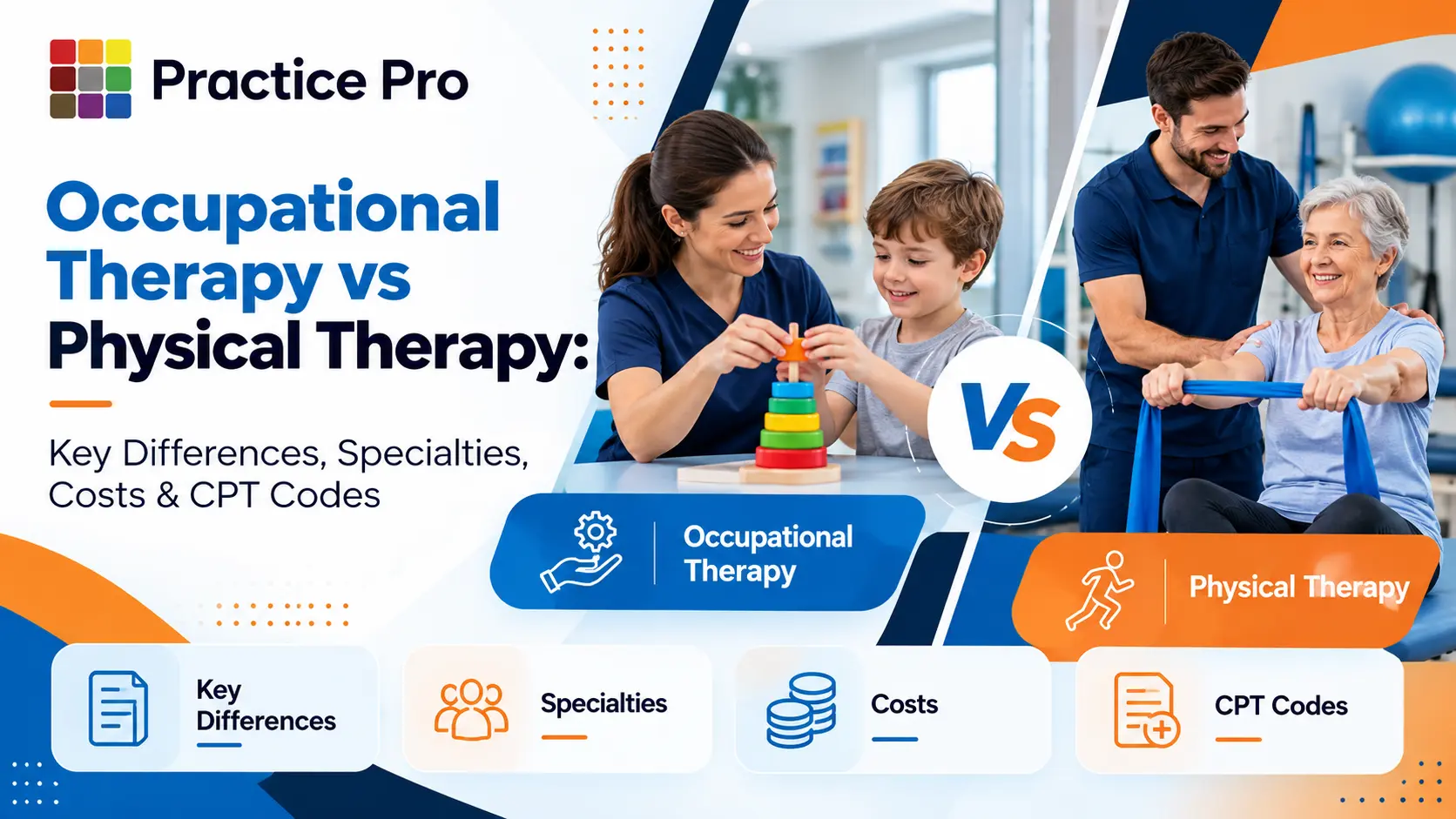
Occupational therapy vs physical therapy: physical therapy (PT) restores movement — strength, mobility, balance and pain relief — while occupational therapy (OT) restores independence in daily activities like dressing, cooking, working and self-care. PT asks "can you move?"; OT asks "can you do what you need to do?"
- PT focus — gross motor skills, walking, strength, pain
- OT focus — fine motor, ADLs, cognition, sensory
- PT degree — Doctor of Physical Therapy (DPT)
- OT degree — master's or doctorate in OT
- PT eval codes — 97161–97163 · GP modifier
- OT eval codes — 97165–97167 · GO modifier
Occupational therapy vs physical therapy is one of the most common questions in rehab — from patients deciding which therapist to see, to students choosing a career, to clinic owners adding a second discipline. Both help people recover after injury, illness or surgery, but they measure success differently. This guide explains the real differences between occupational and physical therapy, with a side-by-side chart, specialties, costs and the CPT codes each uses.
What Is Physical Therapy vs Occupational Therapy?
Physical therapy (PT)
Physical therapy is healthcare that improves movement and reduces pain through exercise, manual therapy, gait and balance training and patient education.
Occupational therapy (OT)
Occupational therapy is healthcare that helps people do the everyday activities ("occupations") they need and want to do — self-care, work, school and play.
A simple way to remember the difference between occupational therapy and physical therapy: after a knee replacement, the physical therapist helps you walk again; the occupational therapist helps you get in and out of the shower, put on socks and get back to work safely.
Occupational Therapy vs Physical Therapy: Side-by-Side Chart
| Category | Physical therapy (PT) | Occupational therapy (OT) |
|---|---|---|
| Main goal | Restore movement, strength & reduce pain | Restore independence in daily activities |
| Focus | Gross motor skills, walking, balance, mobility | Fine motor skills, ADLs, cognition, sensory processing |
| Typical session | Therapeutic exercise, manual therapy, gait training | Task practice, adaptive equipment, home & work modifications |
| Body area | Whole body, spine, lower & upper extremities | Often upper extremity & hand, plus mind and environment |
| Common patients | Back pain, sports injuries, post-surgery, falls | Stroke, hand injuries, autism, dementia, developmental delays |
| Degree | Doctor of Physical Therapy (DPT) | Master's or doctorate in OT (MOT/MSOT/OTD) |
| Assistant role | Physical therapist assistant (PTA) | Certified occupational therapy assistant (COTA) |
| Evaluation CPT codes | 97161, 97162, 97163 · re-eval 97164 | 97165, 97166, 97167 · re-eval 97168 |
| Medicare modifier | GP | GO |
| Settings | Outpatient clinics, hospitals, sports, home health | Hospitals, schools, rehab, mental health, home health |
Conditions Treated: Occupational Therapy vs Physical Therapy
The conditions each discipline treats are where the occupational therapy vs physical therapy difference becomes clearest for patients.
Physical therapy often treats
- Back, neck, knee and shoulder pain
- Sports injuries and ACL recovery
- Joint replacement and post-surgical rehab
- Balance problems and fall prevention
- Arthritis, Parkinson's and MS mobility
- Pelvic floor and vestibular disorders
Occupational therapy often treats
- Stroke and brain injury recovery
- Hand, wrist and carpal tunnel injuries
- Autism, ADHD and sensory processing
- Developmental delays and handwriting
- Dementia and low vision
- Return-to-work and home safety
Occupational vs Physical Therapy: Which One Do You Need?
When weighing occupational vs physical therapy, start with your goal rather than your diagnosis.
- Choose physical therapy if your goal is less pain, more strength, better range of motion, or walking and moving safely.
- Choose occupational therapy if your goal is getting dressed, bathing, cooking, writing, working or managing daily routines independently.
- Choose both after a stroke, major surgery, brain injury or for children with developmental delays — the two therapies complement each other.
Tip: Your doctor can refer you to either, and in many states you can see a physical therapist directly. Check your insurance for referral and visit-limit rules before your first visit.
Types of Physical Therapy & Physical Therapy Specialties
PT specialties (physical therapy specialties) are recognized by the American Board of Physical Therapy Specialties (ABPTS). The main types of physical therapy — and the kinds of physical therapists who provide them — include:
Orthopedic PT
Muscles, bones and joints — back pain, fractures, joint replacements.
Sports PT
Athletic injuries, return-to-sport and injury prevention.
Neurologic PT
Stroke, Parkinson's, MS and spinal cord injury.
Geriatric PT
Balance, fall prevention and mobility for older adults.
Pediatric PT
Gross motor development and conditions like cerebral palsy.
Cardiovascular & pulmonary PT
Endurance after heart or lung conditions.
Women's & pelvic health
Pelvic floor, pregnancy and postpartum care.
Oncology, wound & electrophysiology
Cancer rehab, wound care and nerve/muscle testing.
See how Practice Pro supports every physical therapy specialty with specialty-specific templates.
Types of Occupational Therapy & Specialty Certifications in Occupational Therapy
The American Occupational Therapy Association (AOTA) offers board certifications in gerontology, mental health, pediatrics and physical rehabilitation, plus specialty certifications in areas such as driving and community mobility, environmental modification, feeding, eating and swallowing, low vision and school systems. Common types of occupational therapy and OT specialties include:
Pediatric OT
Fine motor skills, sensory processing, handwriting and play.
Hand therapy
Hand and upper-extremity injuries, often with custom orthoses.
Geriatric OT
Safe independent living, home modification and dementia care.
Mental health OT
Routines, coping skills and life skills for daily function.
Neurologic rehab OT
Stroke and brain injury recovery for self-care and cognition.
Driving, low vision & school-based OT
Community mobility, vision adaptations and classroom participation.
Occupational Therapy vs Physical Therapy Careers: Education & Outlook
Physical therapists complete a Doctor of Physical Therapy (DPT) program, pass the National Physical Therapy Examination and get a state license. Occupational therapists complete an accredited master's or entry-level doctoral OT program, pass the NBCOT exam and get a state license. Both careers are growing: the U.S. Bureau of Labor Statistics projects employment growth of about 14% for physical therapists and 11% for occupational therapists over the decade.
How Much Does Physical Therapy Cost? (And How Much Is OT?)
How much is physical therapy per visit? Here is how occupational therapy vs physical therapy costs compare.
How much physical therapy costs depends mostly on your insurance. Insured patients usually pay a copay or coinsurance per visit; self-pay rates vary widely by state, clinic and visit length, and evaluations usually cost more than follow-up visits. Occupational therapy is priced in a similar way.
- With insurance: copay or coinsurance per visit, after any deductible.
- Medicare: covers medically necessary outpatient PT and OT; beyond the annual threshold the clinic adds the KX modifier to show continued need. PT and speech therapy share one threshold; OT has a separate one.
- Without insurance: ask for the clinic's cash or package rate — many clinics offer discounted self-pay plans.
For clinics, eligibility checks before the visit prevent surprise bills and denied claims.
OT vs PT CPT Codes: Evaluations, Treatment & Modifiers
OT CPT codes (occupational therapy CPT codes) and PT CPT codes share many treatment codes but use different evaluation codes and modifiers. Here are the most-used occupational therapy billing codes and PT billing codes:
| CPT code | Description | Used by |
|---|---|---|
| 97161 · 97162 · 97163 | PT evaluation — low, moderate, high complexity | PT only |
| 97164 | PT re-evaluation | PT only |
| 97165 · 97166 · 97167 | OT evaluation — low, moderate, high complexity | OT only |
| 97168 | OT re-evaluation | OT only |
| 97110 | Therapeutic exercise (timed, 15 min) | PT & OT |
| 97112 | Neuromuscular re-education (timed) | PT & OT |
| 97140 | Manual therapy (timed) | PT & OT |
| 97530 | Therapeutic activities (timed) | PT & OT |
| 97535 | Self-care / home management training (timed) | Mostly OT |
| 97760 · 97763 | Orthotic management & training | PT & OT (common in hand therapy) |
See the full PT CPT codes list and the Medicare 8-minute rule for unit calculations.
For clinic owners
OT vs PT Billing Differences Every Clinic Should Know
Bill PT services with the GP modifier and OT services with GO, use the discipline's own evaluation codes, apply the 8-minute rule to timed codes, and track the KX threshold separately for OT versus PT and speech.
- Separate plans of care — each discipline needs its own evaluation, goals and certified plan.
- Right modifier on every line — GP for PT, GO for OT, GN for SLP.
- KX tracking — OT's threshold is separate from the combined PT and SLP threshold.
- Shared codes, different documentation — 97530 billed by OT should describe functional, task-based activity.
- 2026 reimbursement — the Medicare conversion factor is $33.4009 (non-QP), so every clean claim counts.
Practice Pro's occupational therapy software and physical therapy practice management software apply the right codes, modifiers and unit math automatically — on one patient record.
Occupational Therapy vs Physical Therapy: Better Together
The occupational therapy vs physical therapy question isn't always either/or. The strongest outcomes often come when OT and PT treat the same patient with one shared plan. A stroke patient might work with PT on walking and balance, and with OT on dressing, feeding and returning home safely. In multi-discipline clinics, a single schedule and record — with AI documentation for both disciplines — keeps the team aligned and the billing clean.
Adding OT to a PT clinic? Practice Pro runs PT, OT, SLP and pediatric therapy on one platform — one record, one schedule, one billing engine. Book a demo.
Occupational Therapy vs Physical Therapy: FAQs
Sources
- American Physical Therapy Association (APTA) and American Board of Physical Therapy Specialties — PT specialties.
- American Occupational Therapy Association (AOTA) — board and specialty certifications.
- U.S. Bureau of Labor Statistics, Occupational Outlook Handbook — physical and occupational therapists.
- CMS — Medicare therapy services, KX modifier and CY 2026 Physician Fee Schedule.