

How we verified this guide: every code and description was checked against the FY2026 ICD-10-CM code set (CDC/NCHS and CMS, effective October 1, 2025–September 30, 2026) and cross-referenced with DSM-5-TR terminology. Coding rules change each fiscal year; always confirm against the current official release and payer policy. See sources & references.
ADHD ICD-10 Codes in 20 Seconds
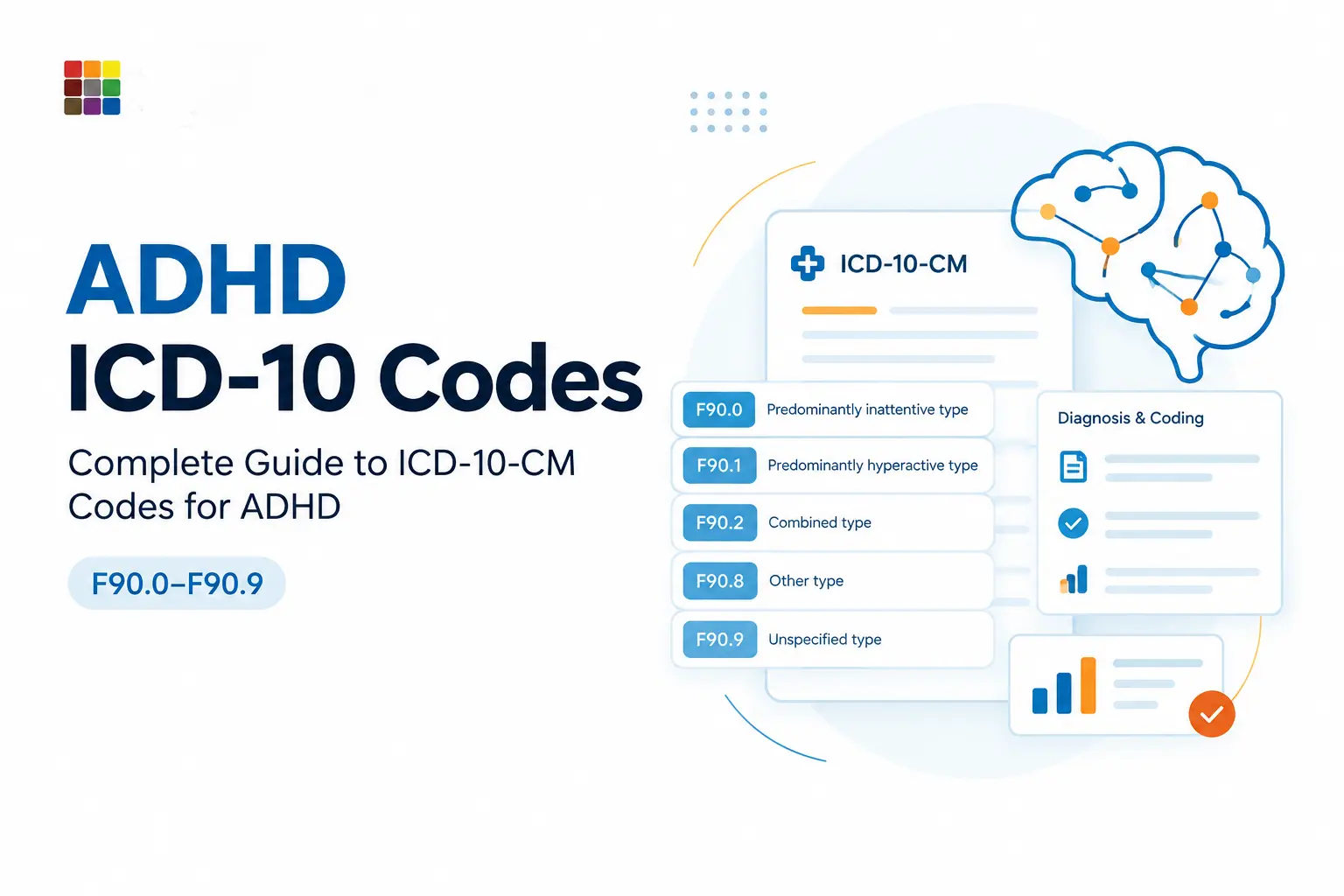
- ADHD is coded in the F90 family: F90.0 inattentive, F90.1 hyperactive, F90.2 combined, F90.8 other, F90.9 unspecified.
- F90 on its own is a category header and is not billable — always code to the documented presentation.
- DSM-5-TR uses the same F90.x codes but calls them "presentations"; ICD-10-CM labels them "types."
- Combined type (F90.2) is the most commonly used ADHD code; use F90.9 (unspecified) only when the type isn't documented — not as a default.
- ICD-11 codes ADHD as 6A05, but U.S. claims still use ICD-10-CM.
Quick Answer: What Is the ICD-10 Code for ADHD?
The ICD-10-CM code for ADHD is in the F90 category: F90.0 (predominantly inattentive type), F90.1 (predominantly hyperactive type), F90.2 (combined type), F90.8 (other type), and F90.9 (unspecified type). Assign the code that matches the documented presentation. F90 by itself is a non-billable category header, so it should not appear on a claim on its own.
In other words, there is no single "ADHD code" — there is a family of five billable codes, and the right one depends on what the clinician documented. The rest of this guide breaks down each code, shows how the ICD-10-CM "types" line up with DSM-5 "presentations," and covers the documentation and edits that keep these codes clean.
ADHD ICD-10-CM Codes at a Glance
There are five billable ICD-10-CM codes for ADHD (F90.0, F90.1, F90.2, F90.8, F90.9) plus the non-billable parent category F90. Each specific code corresponds to a DSM-5 presentation of attention-deficit/hyperactivity disorder.
| ICD-10-CM code | Description | DSM-5 presentation | Billable |
|---|---|---|---|
| F90 | Attention-deficit hyperactivity disorders (category) | — | No — header only |
| F90.0 | ADHD, predominantly inattentive type | Predominantly inattentive | Yes |
| F90.1 | ADHD, predominantly hyperactive type | Predominantly hyperactive-impulsive | Yes |
| F90.2 | ADHD, combined type | Combined | Yes |
| F90.8 | ADHD, other type | Other specified | Yes |
| F90.9 | ADHD, unspecified type | Unspecified | Yes |
Verified against the FY2026 ICD-10-CM code set (effective Oct 1, 2025 – Sep 30, 2026).
F90.0 — ADHD, Predominantly Inattentive Type
F90.0 is the ICD-10-CM code for attention-deficit hyperactivity disorder, predominantly inattentive type — the presentation once commonly called ADD. It applies when inattention (difficulty sustaining focus, following through, or organizing) is the dominant pattern and hyperactive-impulsive symptoms are minimal.
Use F90.0 when the record documents an inattentive presentation: a pattern of not paying close attention to detail, being easily distracted, losing things, or struggling to finish tasks, without a full hyperactive-impulsive picture. In DSM-5-TR terms, this is the "predominantly inattentive presentation," and it is frequently the code used for adults and for girls, whose hyperactivity is often less visible.
F90.1 — ADHD, Predominantly Hyperactive Type
F90.1 is the ICD-10-CM code for attention-deficit hyperactivity disorder, predominantly hyperactive type (predominantly hyperactive-impulsive presentation). It applies when hyperactivity and impulsivity dominate — fidgeting, restlessness, difficulty waiting, interrupting — with limited inattentive symptoms.
F90.1 is the least frequently used of the three main presentation codes, and it is relatively uncommon in adults; many people who presented as hyperactive in childhood develop more inattentive features over time and are later coded F90.0 or F90.2. Reserve F90.1 for records that genuinely document a predominantly hyperactive-impulsive pattern.
F90.2 — ADHD, Combined Type
F90.2 is the ICD-10-CM code for attention-deficit hyperactivity disorder, combined type — the presentation with clinically significant symptoms of both inattention and hyperactivity-impulsivity. It is the most commonly assigned ADHD code.
Use F90.2 when the documentation supports both symptom domains together. Because combined type is the most prevalent presentation, F90.2 is the code coders see most often — but it should still be driven by the note, not selected by default. When both patterns are clearly documented, F90.2 is the most specific and accurate choice.
F90.8 — ADHD, Other Type
F90.8 is the ICD-10-CM code for attention-deficit hyperactivity disorder, other type. It is used for a documented ADHD presentation that does not fit the inattentive, hyperactive, or combined categories — for example, an "other specified" or atypical presentation the clinician describes.
F90.8 is uncommon and should be supported by documentation that explains why a more standard presentation code does not apply. If the note simply doesn't specify the type, the correct code is usually F90.9 (unspecified), not F90.8.
F90.9 — ADHD, Unspecified Type
F90.9 is the ICD-10-CM code for attention-deficit hyperactivity disorder, unspecified type. It applies when ADHD is confirmed but the record does not specify the presentation — for instance, at an initial visit before the subtype is established.
F90.9 is a legitimate, billable code, but it is meant for cases where the type genuinely isn't documented — not as a shortcut. When the note supports a specific presentation, a more specific F90.x code is the accurate choice, and payers increasingly expect that specificity. Treat F90.9 as a stepping stone: revisit it as assessment clarifies the presentation.
What Does F90.9 Mean?
F90.9 means "attention-deficit hyperactivity disorder, unspecified type." The F indicates a mental, behavioral, or neurodevelopmental disorder, 90 specifies attention-deficit hyperactivity disorders, and the final 9 denotes the unspecified subtype. It confirms an ADHD diagnosis without identifying whether the presentation is inattentive, hyperactive, or combined.
Providers commonly use F90.9 during initial evaluations, when symptom patterns are still emerging, or when documentation doesn't yet distinguish a subtype. It ensures the diagnosis is captured while leaving room to refine the code once the presentation is clearer.
What Is the ICD-10 Code for ADHD Combined Type?
The ICD-10 code for ADHD combined type is F90.2 — attention-deficit hyperactivity disorder, combined type. It's used when a patient has significant symptoms of both inattention and hyperactivity-impulsivity, and it is the most frequently assigned ADHD code.
What Is the ICD-10 Code for Inattentive ADHD?
The ICD-10 code for inattentive ADHD is F90.0 — attention-deficit hyperactivity disorder, predominantly inattentive type. It applies when inattention is the dominant pattern and hyperactive-impulsive symptoms are minimal. In DSM-5-TR this is the "predominantly inattentive presentation."
F90.0 vs. F90.2: What's the Difference?
F90.0 (inattentive type) is used when inattention dominates and hyperactive-impulsive symptoms are minimal. F90.2 (combined type) is used when both inattention and hyperactivity-impulsivity are clinically significant. The difference is whether one symptom domain or both are documented.
| F90.0 — Inattentive | F90.2 — Combined | |
|---|---|---|
| Core pattern | Inattention predominates | Inattention + hyperactivity-impulsivity |
| DSM-5 presentation | Predominantly inattentive | Combined |
| What the note shows | Inattentive symptoms met; hyperactive-impulsive not fully met | Both symptom domains met |
| Typical use | Common in adults and girls | Most common overall |
Symptom thresholds are set by DSM-5-TR (generally six or more symptoms in a domain for children, five or more for those 17 and older) and are applied by the diagnosing clinician.
ADHD ICD-10 vs. ADHD Diagnosis (DSM-5 & ICD-11)
In the U.S., clinicians diagnose ADHD using DSM-5-TR criteria, then report the diagnosis on claims using ICD-10-CM codes. DSM-5-TR and ICD-10-CM share the same F90.x codes, but DSM-5 calls them "presentations" while ICD-10-CM calls them "types." ICD-11 uses a different code (6A05), but U.S. billing still relies on ICD-10-CM.
This is a frequent point of confusion. The DSM-5-TR is the diagnostic manual; ICD-10-CM is the code set used for billing and reporting. They were aligned so that a DSM-5 ADHD diagnosis maps directly to an F90.x code — the inattentive presentation to F90.0, combined presentation to F90.2, and so on. Historically, ICD-10 didn't even use the word "ADHD"; it described "hyperkinetic disorders," which is why the terminology can look dated.
Globally, the WHO's ICD-11 reclassifies ADHD under code 6A05 (with 6A05.0, 6A05.1, 6A05.2, and 6A05.Z presentations) inside neurodevelopmental disorders. ICD-11 took effect internationally in 2022, but the United States continues to use ICD-10-CM for HIPAA-covered claims — so for U.S. coding today, the F90 family is still the answer.
Excludes2 Notes & Related Codes
The F90 category carries Excludes2 notes for anxiety disorders (F40.-, F41.-), mood (affective) disorders (F30–F39), pervasive developmental disorders (F84.-), and schizophrenia (F20.-). An Excludes2 note means the excluded condition is not part of ADHD, but a patient may have both — so both codes can be reported together when documented.
| Excludes2 (may report together if documented) | Code range |
|---|---|
| Anxiety disorders | F40.-, F41.- |
| Mood [affective] disorders | F30–F39 |
| Pervasive developmental disorders (e.g., autism) | F84.- |
| Schizophrenia | F20.- |
ADHD also frequently co-occurs with oppositional defiant disorder (F91.3) and other conditions; when a comorbid condition is documented, code it in addition to the ADHD code. Where the record supports it, follow any applicable official instructional notes (for example, additional codes for long-term medication use) per the ICD-10-CM guidelines and payer policy.
ICD-10-CM Documentation Considerations
Accurate ADHD coding depends on documentation that names the presentation, supports the diagnosis across settings, and reflects onset in the developmental period. The more specific the note, the more specific — and defensible — the code.
- Code to the highest specificity supported. If the note documents a presentation, use F90.0, F90.1, or F90.2 rather than F90.9.
- Support the diagnosis across settings. ADHD symptoms should be documented as impairing in more than one setting (e.g., home and school or work).
- Reflect developmental onset. DSM-5-TR requires several symptoms before age 12; documentation should reflect a developmental, not sudden-onset, pattern.
- Don't code "rule out" as confirmed. In the outpatient setting, a "rule out ADHD" or "R/O ADHD" note is not a confirmed diagnosis — code the documented signs and symptoms instead until ADHD is established.
- Keep the diagnosis and the record aligned. The billed code should match the clinician's documented presentation, not a default or the most common code.
For therapy practices, tying diagnosis capture to defensible clinical documentation is what keeps ICD-10 codes accurate at the point of care and clean when they reach billing and RCM.
Common Mistakes When Using ADHD ICD-10 Codes
- Reporting the non-billable parent category F90 instead of a specific F90.x code.
- Defaulting to F90.9 (unspecified) when the note actually documents a presentation.
- Coding F90.8 (other) when the type simply isn't specified — that's F90.9.
- Coding "rule out" ADHD as a confirmed diagnosis in the outpatient setting.
- Confusing the DSM-5 diagnosis with the ICD-10-CM code, or assuming ICD-11 (6A05) applies to U.S. claims.
- Missing documented comorbidities (e.g., anxiety, ODD) that Excludes2 rules allow to be coded alongside ADHD.
- Working from an outdated code file instead of the current fiscal-year ICD-10-CM release.
Specificity protects reimbursement. Payers increasingly scrutinize unspecified codes, so the closer the code matches the documented presentation, the lower the denial risk.
Where ADHD Codes Appear in PT, OT & SLP Practices
ADHD is diagnosed by physicians and behavioral-health clinicians, but its ICD-10 codes regularly appear in PT, OT, SLP, and pediatric therapy records — as a referring or secondary diagnosis on charts, referrals, and claims — because therapy is often part of a child's multimodal support plan.
Occupational therapy, in particular, frequently supports children with ADHD on fine-motor skills, self-regulation, sensory strategies, and classroom function, and pediatric PT and SLP teams see these patients too. In those settings, the therapy plan of care is usually built around the functional deficits being treated, while the ADHD code (F90.x) may travel with the patient as a referring or comorbid diagnosis. Getting that code recorded correctly keeps the whole record — and the claim — consistent.
Practice Pro supports discipline-specific workflows for PT, OT, and SLP and a pediatric therapy EMR where documentation, diagnosis capture, scheduling, and billing live in one connected system.
From documentation to clean claims
Capture the Right Diagnosis, Once
When diagnosis capture is built into the clinical note, the correct ICD-10 code follows the patient through scheduling, documentation, and billing — with fewer transcription errors and less rework.
Practice Pro is a rehab-specific EMR built for PT, OT, SLP, and pediatric therapy — not adapted from a hospital system. Diagnosis and documentation stay connected, so the codes on the chart match the codes on the claim:
Working with related coding too? See our timed vs untimed CPT codes guide and the 8-minute rule chart & calculator. Or book a free demo.
Frequently Asked Questions
Sources & References
- Centers for Disease Control and Prevention (CDC) — Attention-Deficit/Hyperactivity Disorder (ADHD).
- CDC / National Center for Health Statistics (NCHS) — official ICD-10-CM code files (FY2026).
- Centers for Medicare & Medicaid Services (CMS) — Psychiatry and Psychology Services coverage article listing F90.0–F90.9.
- American Psychiatric Association — Diagnostic and Statistical Manual of Mental Disorders, Fifth Edition, Text Revision (DSM-5-TR).
- World Health Organization — ICD-11 for Mortality and Morbidity Statistics, code 6A05 (Attention deficit hyperactivity disorder).
- National Institute of Mental Health (NIMH) — Attention-Deficit/Hyperactivity Disorder.
Disclaimer: This article is for educational reference and reflects our understanding of the FY2026 ICD-10-CM code set and DSM-5-TR terminology as of September 2026. It is not medical advice, a diagnosis, or professional coding advice. ADHD is diagnosed by a qualified clinician. ICD-10-CM codes and payer rules change; always verify against the current official code set and each payer's requirements before billing. Where clinical or coding judgment is required, consult a licensed clinician or a certified professional coder.