

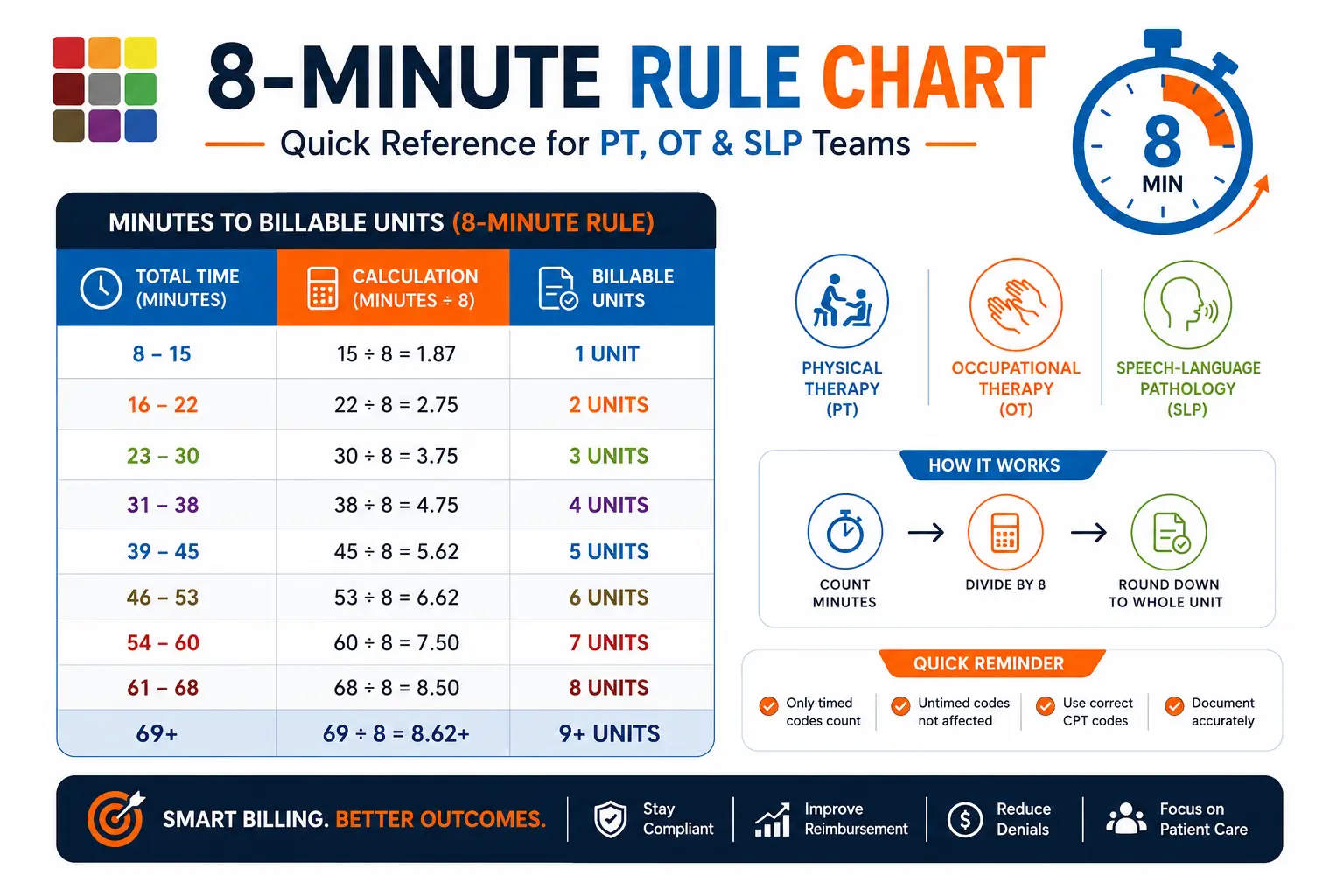
How we built this chart: the unit bands, examples and calculator logic were checked against CMS's timed-code methodology (Medicare Claims Processing Manual, Chapter 5) and AMA CPT® conventions in effect for 2026. It reflects U.S. Medicare Part B outpatient therapy. See sources & references.
The 8-Minute Rule Chart in 20 Seconds
- Total every timed minute in the visit, then read the band: 8–22 min = 1 unit, 23–37 = 2, 38–52 = 3, 53–67 = 4, and +15 minutes for each unit after.
- The same chart works for PT, OT and SLP timed CPT codes billed to Medicare Part B — only the discipline modifier (GP / GO / GN) differs.
- Only timed, one-on-one codes count toward the total. Untimed services — evaluations, hot/cold packs, unattended e-stim — are billed separately.
- Some commercial payers use the AMA "Rule of Eights" (Substantial Portion Methodology), which counts each code separately and can yield a different total — always check the payer.
- Want the underlying math and the Rule-of-Eights mechanics in depth? Read the full Medicare 8-minute rule guide.
What Is the 8-Minute Rule?
The 8-minute rule is the Medicare rule that decides how many units you can bill for timed, one-on-one outpatient therapy delivered in 15-minute increments. You need at least 8 minutes of a timed service to bill one unit; each additional unit needs another 15 minutes. It applies to physical therapy, occupational therapy and speech therapy timed CPT codes under Medicare Part B.
In practice, you don't do that math by hand — you total the visit's timed minutes and read the chart below (or use the calculator). The chart already folds in the "8 or more leftover minutes earns one more unit" logic, so a lookup replaces the arithmetic. For the full derivation, the Rule-of-Eights comparison, and the annual threshold details, see the complete Medicare 8-minute rule guide.
The 8-Minute Rule Chart (Minutes to Billable Units)
The 8-minute rule chart converts total timed therapy minutes into billable Medicare units: 8–22 minutes = 1 unit, 23–37 = 2 units, 38–52 = 3 units, 53–67 = 4 units, and each additional unit needs another full 15 minutes. It applies to timed PT, OT and SLP CPT codes under Medicare Part B.
| Total timed minutes | Billable units |
|---|---|
| 8 – 22 minutes | 1 unit |
| 23 – 37 minutes | 2 units |
| 38 – 52 minutes | 3 units |
| 53 – 67 minutes | 4 units |
| 68 – 82 minutes | 5 units |
| 83 – 97 minutes | 6 units |
| 98 – 112 minutes | 7 units |
| 113 – 127 minutes | 8 units |
| 128 – 142 minutes | 9 units |
| 143 – 157 minutes | 10 units |
| 158 – 172 minutes | 11 units |
| 173 – 187 minutes | 12 units |
Pattern to memorize: after the first unit at 8 minutes, every new unit opens 15 minutes later (8, 23, 38, 53, 68…).
↑ Each 15-minute step unlocks one more unit — e.g. 53 timed minutes = 4 units.
8-Minute Rule Calculator
Enter your timed treatment minutes and the calculator returns billable units under the Medicare 8-minute rule. Switch to "By service line" to enter multiple timed CPT codes and see how the units are allocated, or switch the method to the AMA Rule of Eights to compare. It's an educational reference tool — always confirm against your documented minutes and each payer's policy.
Prefer paper? The chart above prints cleanly as a quick-reference. To skip the lookup entirely, therapy software can total timed minutes and apply the rule as clinicians document — see automating the chart below.
Minutes-to-Units Quick Reference
Common 8-minute rule conversions for timed therapy: 8 min = 1 unit, 15 = 1, 20 = 1, 22 = 1, 23 = 2, 30 = 2, 38 = 3, 45 = 3, 53 = 4, 60 = 4, 68 = 5, 75 = 5, and 83 = 6. The jump points — 8, 23, 38, 53, 68, 83 — are each 15 minutes apart.
| Timed minutes | Billable units | Why (band) |
|---|---|---|
| 8 minutes | 1 unit | First minute of the 8–22 band |
| 15 minutes | 1 unit | Inside 8–22 |
| 20 minutes | 1 unit | Inside 8–22 |
| 22 minutes | 1 unit | Top of the 8–22 band |
| 23 minutes | 2 units | First minute of 23–37 |
| 30 minutes | 2 units | Inside 23–37 |
| 38 minutes | 3 units | First minute of 38–52 |
| 40 minutes | 3 units | Inside 38–52 |
| 45 minutes | 3 units | Inside 38–52 |
| 53 minutes | 4 units | First minute of 53–67 |
| 60 minutes | 4 units | Inside 53–67 |
| 68 minutes | 5 units | First minute of 68–82 |
| 75 minutes | 5 units | Inside 68–82 |
| 83 minutes | 6 units | First minute of 83–97 |
How to Calculate 8-Minute Rule Units
Add up only the timed, one-on-one CPT minutes for the visit, exclude untimed services, then match the total to the chart — that band's unit count is what you bill. When several timed codes are used, allocate the units to the codes with the most minutes.
- Add the timed minutes. Sum the direct, one-on-one minutes for time-based codes such as 97110, 97112, 97116, 97140 and 97530.
- Exclude untimed services. Evaluations, hot/cold packs and unattended modalities are billed separately and never enter this total.
- Find the band. Match your total to a row in the chart above — that row's unit count is your bill.
- Allocate across codes. When more than one timed code was used, distribute the units to the codes with the most minutes (largest-remainder method — see the worked examples below).
8-Minute Rule for Physical Therapy
The chart applies fully to physical therapy. Total your timed PT minutes for codes like 97110, 97112, 97116, 97140 and 97530, then read the band. Medicare outpatient PT lines carry the GP therapy modifier.
Physical therapy is where most billers meet the rule first, because so many core PT services are time-based. The codes that feed the chart most often:
| Common timed PT code | Service |
|---|---|
| 97110 | Therapeutic exercise |
| 97112 | Neuromuscular re-education |
| 97116 | Gait training |
| 97140 | Manual therapy |
| 97530 | Therapeutic activities |
| 97035 | Ultrasound (timed modality) |
Accurate units start with accurate minutes, so clinical documentation with start/stop times protects every unit on the chart. Linking timed codes straight to the claim is what a rehab-specific therapy software platform and its billing and RCM are built to do.
8-Minute Rule for Occupational Therapy (OT)
Occupational therapy uses the same chart. Total the timed OT minutes for codes such as 97530 (therapeutic activities) and 97535 (self-care/ADL training), then read the band. Medicare OT lines carry the GO modifier, and OT evaluations (97165–97167) are untimed.
For OT billing, the chart behaves identically — only the codes and the modifier change. Common timed occupational therapy codes:
| Common timed OT code | Service |
|---|---|
| 97530 | Therapeutic activities |
| 97535 | Self-care / ADL training |
| 97110 | Therapeutic exercise |
| 97112 | Neuromuscular re-education |
| 97165–97167 | OT evaluations (untimed — one unit each) |
8-Minute Rule for Speech Therapy (SLP)
The chart applies to speech therapy only for timed SLP codes such as 97129 and 97130 (cognitive intervention). Most core speech-language pathology services — 92507 (treatment) and 92526 (dysphagia) — are untimed and billed once per session, so the 8-minute rule usually does not apply to them.
This is the detail that trips up new SLP billers: much of speech-language pathology billing is untimed. Use the chart only for the timed codes, and bill the rest per session. A quick reference:
| SLP code | Service | Chart applies? |
|---|---|---|
| 97129 / 97130 | Cognitive intervention (timed) | Yes — use the chart |
| 92507 | Speech/language treatment | No — one unit per session |
| 92526 | Dysphagia (swallowing) therapy | No — one unit per session |
| 92521–92524 | SLP evaluations | No — untimed |
Timed vs. Untimed CPT Codes (What Goes on the Chart)
Only timed, one-on-one CPT codes go on the 8-minute rule chart. Untimed, service-based codes — evaluations, hot/cold packs, mechanical traction, and unattended electrical stimulation — are billed once regardless of time and are left out of the timed total.
| Category | Examples | On the chart? |
|---|---|---|
| Timed — PT/OT | 97110, 97112, 97116, 97140, 97530, 97535, 97032 (attended e-stim), 97035 (ultrasound) | Yes — counts toward units |
| Timed — SLP | 97129 / 97130 (cognitive intervention) | Yes — per code rules |
| Untimed — evals | 97161–97163 (PT), 97165–97167 (OT), 92521–92524 (SLP) | No — one unit each |
| Untimed — modalities | 97010 hot/cold packs, 97012 mechanical traction, unattended e-stim (Medicare: G0283) | No — service-based |
Note: for unattended electrical stimulation, Medicare requires HCPCS G0283 rather than CPT 97014. Confirm current CPT® descriptors each year — a code's timing status can change. For a full breakdown, see timed vs untimed CPT codes.
The 8-Minute Rule Chart vs. the Rule of Eights
This chart follows the Medicare 8-minute rule, which adds all timed minutes together before assigning units. The AMA Rule of Eights — also called the Substantial Portion Methodology (SPM) and used by some commercial payers — counts each timed code on its own and usually will not combine leftover minutes, so the same visit can produce a different unit total.
| Approach | How units are counted | Leftover minutes |
|---|---|---|
| Medicare 8-minute rule (this chart) | All timed minutes added together, then converted | Combined across codes (mixed remainders allowed) |
| AMA Rule of Eights (SPM) | Each timed code evaluated separately | Usually not combined |
Because the methods treat leftovers differently, the Rule of Eights can sometimes yield more units when several short services are provided — which is exactly why you should apply the method the payer's contract requires, not a default. The deeper mechanics live in our Medicare 8-minute rule guide.
Worked Examples
Three visits, three totals, three chart look-ups.
Example 1 — 43 timed minutes (single band)
A PT visit records 97110 for 22 minutes and 97140 for 21 minutes = 43 timed minutes. On the chart, 43 lands in the 38–52 band → 3 units, split toward the codes with the most minutes.
Example 2 — 72 timed minutes (multiple codes)
An OT visit records 97530 for 30 minutes, 97535 for 24 minutes, and 97110 for 18 minutes = 72 timed minutes. On the chart, 72 sits in the 68–82 band → 5 units across those three codes.
Example 3 — mixed remainder (the leftover-unit case)
A PT visit records 97110 for 7 minutes and 97140 for 8 minutes = 15 timed minutes → 1 unit. Because 97140 has more minutes (8 vs 7), the single unit is billed as 97140. This is the classic mixed-remainder scenario the CMS method handles but the per-code Rule of Eights would not (neither 7 nor 8 minutes alone clears the threshold the same way). Try it in the calculator's "By service line" mode.
Rule to remember: a single code can never earn more units than its own minutes support — allocate by largest remaining time, not by which code pays most.
Mistakes & Documentation That Protect Your Units
The rule is simple, but these errors still drive denials and audits:
- Adding untimed codes (hot packs, evaluations) into the timed total
- Always landing exactly on a jump point — repeatedly billing 23, 38 or 53 minutes looks like rounding up
- Billing units the documented minutes don't support
- Using this Medicare chart for a Rule-of-Eights commercial payer
- Missing start/stop times, leaving units indefensible in an audit
Every unit on the chart must be backed by documented minutes. If the minutes aren't in the note, the unit isn't defensible — which is why defensible documentation and clean billing go together.
Skip the manual lookup
Automate the 8-Minute Rule Chart
Rehab software can total timed minutes as clinicians document, convert them to billable units, allocate units across codes by largest remainder, and flag any unit the note doesn't support — for PT, OT and SLP.
A printed chart is great for training, but the fastest, most audit-safe path is to let the system do the lookup. When the clinical note connects straight to billing and RCM, timed minutes become correct units without anyone touching a calculator. Practice Pro is one platform built for rehab — not adapted from a generic EHR — across physical therapy, occupational therapy and speech therapy:
Curious how it looks on your workflows? Book a free demo or talk to our team.
Frequently Asked Questions
Sources & References
- Centers for Medicare & Medicaid Services (CMS), Medicare Claims Processing Manual, Chapter 5 — time-based (timed) coding methodology for outpatient therapy.
- American Medical Association (AMA) CPT® guidance — the "Rule of Eights" / Substantial Portion Methodology used by many commercial payers.
- American Physical Therapy Association (APTA) — application of Medicare's timed-code methodology in physical therapy.
- American Occupational Therapy Association (AOTA) — timed-code billing guidance for occupational therapy.
- American Speech-Language-Hearing Association (ASHA) — timed vs untimed coding for speech-language pathology services.
Disclaimer: This chart and calculator are provided for educational reference and reflect our understanding of CMS and AMA guidance as of September 2026. Coding rules and payer policies change; always confirm current CPT® descriptors and each payer's provider manual before billing. This is not legal, coding, or reimbursement advice.