

Key Takeaways
- Physical therapy software is an all-in-one platform combining a PT EMR, scheduling, documentation, billing/RCM, and patient engagement for PT, OT & SLP clinics.
- The best physical therapy software has the EMR built in — not bolted on — so data flows from schedule to note to claim without re-entry.
- AI documentation is the biggest 2026 differentiator. Peer-reviewed research shows real but modest time savings, largest for clinicians who use it consistently.
- Compare vendors on 8 criteria: rehab focus, disciplines, documentation speed, compliance, billing, engagement, pricing, and switching support.
- Practice Pro is a strong all-in-one choice for USA clinics that want one connected platform instead of separate tools.
Running a therapy clinic means juggling scheduling, charting, compliance, and billing every day. The right physical therapy software pulls all of it into one connected platform — so your team spends less time on admin and more time on patient care.
What Is Physical Therapy Software?
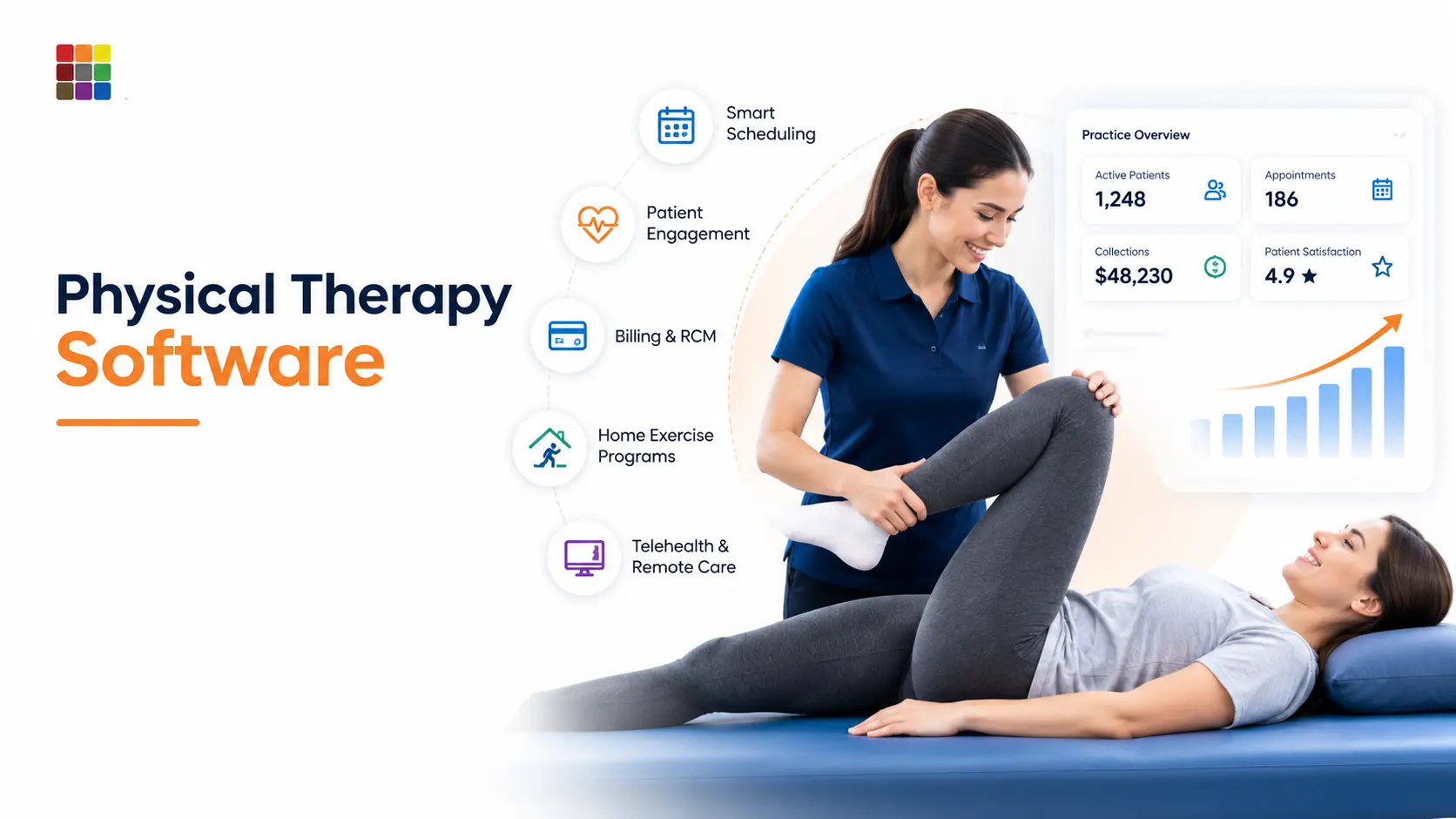
Physical therapy software is an all-in-one platform that helps outpatient rehab clinics manage the full patient journey — from the first appointment to the final paid claim. It combines a physical therapy EMR, scheduling, clinical documentation, billing and revenue cycle management, and patient engagement in one system built for PT, OT, and SLP practices.
Instead of stitching together separate tools for the front desk, the treatment room, and the billing office, purpose-built PT software keeps scheduling, documentation, patient engagement, and revenue cycle management on one patient record.
Historically, clinics ran one product for charting and another for billing — creating double data entry, delayed claims, and compliance gaps. Today's best physical therapy practice management software has the EMR built in, so information flows automatically from the schedule to the note to the claim.
You'll see the same category described in many ways: physical therapist software, physiotherapy software and software for physiotherapists outside the US, and older terms like physical therapy computer software or physical therapy software programs. Whatever the name, modern physical therapy technology means one cloud platform rather than separate programs installed on clinic computers.
In short: Physical therapy software = PT EMR + scheduling + clinical documentation + billing/RCM + patient engagement, purpose-built for PT, OT & SLP practices.
Types of Physical Therapy Software
There are six main types of physical therapy software: EMR/documentation software, practice management and scheduling software, billing and RCM software, home exercise program software, patient engagement software, and all-in-one platforms that combine all five.
| Type | What it handles | Best when… |
|---|---|---|
| PT EMR / documentation (physical therapy electronic medical records software) | Evaluations, SOAP notes, plans of care, outcomes | You only need clinical charting |
| Practice management | Scheduling, intake, authorizations, front desk | Your EMR lacks a usable scheduler |
| Billing & RCM | Charges, claims, denials, payments, A/R | You outsource or specialize billing |
| Home exercise program (HEP) / physical therapy exercise software | Exercise videos, adherence tracking | You need patient homework tools |
| Patient engagement | Reminders, portal, messaging, surveys | No-shows and dropout are the problem |
| All-in-one PT software | All of the above on one record | You want no double entry and one login |
Most growing clinics end up choosing an all-in-one platform, because the costs of disconnected tools — re-keyed data, missed charges, and multiple subscriptions — grow with every new provider and location.
Top 10 Physical Therapy Software Companies & Programs in 2026 (Quick List)
The best physical therapy software platforms in 2026 combine a rehab-specific EMR, scheduling, billing and home exercise programs. Leading physical therapy software companies include Practice Pro, WebPT, Raintree, Prompt, SPRY, TheraOffice, Net Health, Physitrack, Jane and ClinicSense. The best choice depends on clinic size, disciplines, payer mix and how much of the workflow you want on one platform.
Practice ProOur platform
Best for: US PT, OT, SLP and pediatric clinics — solo to multi-location — that want the EMR, scheduling and billing on one patient record.
Key features: AI Voice-to-SOAP notes, AI Fax-to-Intake, real-time insurance eligibility verification, home exercise programs, patient portal and telehealth, billing & RCM with an optional US-based billing team, KPI reporting.
WebPT
Best for: Clinics that want the most widely adopted rehab therapy platform and a large ecosystem.
Key features: Rehab EMR, scheduling, billing, home exercise programs and patient engagement products, with reporting and analytics.
Raintree
Best for: Large, multi-location rehab organizations that need deep customization.
Key features: Enterprise EMR, scheduling, billing and RCM with configurable workflows and reporting.
Prompt
Best for: Growing outpatient clinics that prioritize automation.
Key features: Modern EMR, scheduling and billing with automation across intake, documentation and claims.
SPRY
Best for: Practices focused on AI-driven efficiency.
Key features: AI-assisted documentation and front-office automation with integrated billing.
TheraOffice
Best for: Clinics of many sizes and specialties, from new practices to larger groups.
Key features: Integrated physical therapy EMR with scheduling, billing, patient portal and reporting across PT, OT, SLP and specialties.
Net Health
Best for: Organizations that value reporting and compliance depth.
Key features: Therapy software suite with documentation, analytics and compliance tools.
Physitrack
Best for: Clinicians who want strong home exercise programs and remote care.
Key features: Exercise library, patient app, telehealth and outcome tracking.
Jane
Best for: Smaller allied-health and multi-discipline clinics that want simple booking and charting.
Key features: Online booking, charting, billing and patient communications in one app.
ClinicSense
Best for: Small, often cash-based practices across massage, PT, OT and chiropractic.
Key features: Online booking, intake forms, SOAP notes, reminders and reporting.
How we built this list: Practice Pro makes physical therapy software, so we list our own platform first — please weigh that. Competitor summaries are based on each vendor's public positioning and software-directory profiles (Capterra, Software Advice, G2) as of October 2026. Features change often, so confirm details in a demo with each vendor.
What Is the Best Physical Therapy Software in 2026?
The best physical therapy software in 2026 is an all-in-one, AI-assisted platform purpose-built for PT, OT, and SLP — not a generic medical EHR and not billing bolted onto a separate EMR. There is no single best choice for every clinic; Practice Pro is a strong option for USA clinics that want scheduling, a rehab-specific EMR, AI documentation, referrals, and billing on one connected system.
The pattern among high-performing outpatient practices is consistent: they choose a single, rehab-specific platform where the EMR, scheduling, billing, and engagement share the same data. That's what removes double entry, speeds up claims, and gives clinicians their evenings back. Below we compare Practice Pro honestly against WebPT and other leading physical therapy software, and give you a checklist to score any vendor.
Must-Have Features in Physical Therapy Software
Generic medical EHRs rarely fit the way therapy clinics work. When you evaluate physical therapy software, these are the core features that separate a purpose-built rehab platform from a generic one:
| Feature | What it does | Why it matters |
|---|---|---|
| Therapy EMR | Rehab-specific charting & SOAP notes | Faster, defensible documentation for PT/OT/SLP |
| Smart scheduling | Multi-provider, multi-location calendar | Fewer no-shows, fuller schedules |
| AI documentation | Voice-to-text & note pre-population | Cuts charting time & burnout |
| Billing & RCM | Automated claims & denial checks | Cleaner claims, faster payment |
| Patient engagement | Reminders, portal, digital intake | Better retention & experience |
| Referral management | Track & convert incoming referrals | More new patients from referrers |
| Home exercise programs | Digital HEP with adherence tracking | Better outcomes & plan-of-care adherence |
| Reporting & KPIs | Dashboards for revenue & productivity | Clear visibility into performance |
Physical Therapy EMR Software & Clinical Documentation
A physical therapy EMR is rehab-specific electronic medical record software that understands therapy workflows — evaluations, re-evaluations, plans of care, flowsheets, and progress notes — so documentation is faster to complete and easier to defend in an audit.
At the heart of any great physical therapy software is the EMR. A dedicated physical therapy EMR understands rehab workflows, which means clinical documentation that's faster to complete and easier to defend.
When you compare EMR systems for physical therapy, you'll see several labels for the same core: EMR software for physical therapy, physical therapy EHR software, PT EMR software, physical therapy EMR programs, physical therapy electronic documentation software and physical therapy notes software. The test is the same for all of them: does it understand plans of care, timed codes and therapy modifiers, and does it send the signed note straight to billing?
Documentation is one of the biggest time drains in a clinic, and much of it spills into unpaid hours. Smart templates, carry-forward data, and built-in compliance and medical-necessity prompts hand that time back to your clinicians.
What great therapy documentation includes
- Rehab-specific SOAP note and evaluation templates for PT, OT, and SLP
- Auto-populated data pulled from digital intake and prior visits
- Built-in compliance, CPT coding, and medical-necessity prompts
- Goals, plan of care, recertifications, and outcome measures in one place
- Documentation that flows straight into the billing system
The 2026 game-changer
AI in Physical Therapy Software
AI physical therapy software (also called AI-powered physical therapy software or AI physical therapy EMR software) uses voice-to-text and smart automation to draft clinical notes, pull forward relevant history, and flag missing information before a claim goes out — reducing charting time, denials, and clinician burnout.
Artificial intelligence is the biggest shift in physical therapy software right now — it's why AI physical therapy software has become a category of its own. The evidence is real but should be read honestly: a multisite study published in JAMA in April 2026, across five US academic medical centers, found AI scribe adoption was associated with about 16 fewer minutes of documentation time per 8 hours of scheduled patient care on average. Clinicians who used AI scribes in at least half of their visits saw larger savings — roughly 27 minutes per 8 hours. The study covered physicians and other clinicians rather than therapists specifically, but the lesson carries over: AI documentation pays off most when it's built into the daily workflow and used consistently. AI drafts still need clinician review before a note is signed.
- Drafting SOAP notes from your spoken summary
- Pre-filling evaluations from digital intake forms
- Catching coding & medical-necessity gaps before submission
- Filling open schedule slots from a waitlist
Physical Therapy Billing Software & Revenue Cycle Management
Physical therapy billing software — or better, physical therapy EMR and billing software in one system — connects documentation directly to billing, so charges are captured accurately and claims go out clean the first time. Integrated RCM automates eligibility checks, scrubs claims for errors, and tracks every dollar from visit to payment.
Even the best clinical care doesn't keep a practice open if claims are denied. A strong physical therapy billing system connects documentation directly to billing — and applies rules like the Medicare 8-minute rule so timed units match documented minutes.
When the note and the claim live on the same record, there are fewer places for a charge to be missed or a code to be mistyped — which is why connected physical therapy software tends to make clean claims easier to achieve than juggling separate systems.
- Automated charge capture straight from clinical notes
- Insurance eligibility & authorization checks
- Claim scrubbing to reduce denials before submission
- Clear dashboards for A/R, payments, and denials
Patient Retention & Referral Management
Growth starts with getting more patients through the door — and keeping them engaged through their full plan of care. Physical therapy referral management tools track every incoming referral, reduce leakage, and show which referral sources actually drive visits.
On the patient side, dropout is a real threat to outcomes and revenue. The right physical therapy software improves retention with patient engagement tools — automated reminders, online rescheduling, digital intake, telehealth, and a self-service patient portal.
- Automated appointment reminders & easy online rescheduling
- Waitlist automation that fills cancellations quickly
- Referral tracking from source to booked visit
- Two-way messaging that keeps patients on their plan of care
Home Exercise Programs That Boost Adherence
Outcomes don't stop at the clinic door. Built-in home exercise programs (HEP) let therapists assign personalized exercises with video guidance straight from the EMR. Patients follow their plan at home, log progress, and stay connected — supporting adherence, outcomes, and retention. When physical therapy exercise software is part of the EMR instead of a separate app, exercise software for physical therapists stops being one more login.
- Personalized, video-guided home exercise programs
- Assigned in seconds from the patient's plan of care
- Adherence tracking that feeds back into documentation
How Physical Therapy Software Reduces Therapist Burnout
Burnout is one of the biggest threats to rehab practices. In WebPT's 2023 State of Rehab Therapy report, more than a third of rehab therapy professionals reported being burnt out, with high caseloads and administrative burden among the top drivers.
Modern physical therapy software helps by cutting documentation time with AI, automating reminders and billing, and removing repetitive front-desk work — so therapists focus on patients instead of paperwork.
Best Physical Therapy Software by Practice Type
The best physical therapy software for a solo PT isn't always the best for a 15-location rehab group. Here's what matters most for each type of practice:
Small & solo PT practices
One affordable cloud system for scheduling, notes, and claims — no server, no IT, and simple setup.
Multi-location clinics
Shared templates, central billing, and practice-wide KPIs across every site and provider.
Occupational therapy
OT evaluation templates, functional goals, and hand therapy flowsheets in the same system as PT.
Speech-language pathology
SLP templates, measurable goals, and progress reports for adult and pediatric speech therapy.
Pediatric therapy
PT, OT, and SLP side by side, with a portal and home programs families can follow.
Cash-pay & hybrid clinics
Easy self-pay invoicing and packages alongside insurance billing on the same record.
How Much Does Physical Therapy Software Cost?
Physical therapy software is usually priced per provider per month, sometimes per location, with billing or RCM services often charged as a percentage of collections. Total cost also depends on modules, implementation and data-migration fees, and contract length.
Because pricing models differ so much, compare vendors on total cost of ownership, not the headline monthly fee. Ask every physical therapy software vendor:
- Is pricing per provider, per location, or per visit — and who counts as a "provider"?
- Which modules are included, and which (HEP, AI, portal, billing) cost extra?
- Are there implementation, training, or data-migration fees?
- If billing services are offered, what percentage of collections is charged?
- How long is the contract, and what does it cost to leave?
For an accurate Practice Pro quote scoped to your clinic, request a demo.
Manual Workflows vs. Physical Therapy Software
What does the right physical therapy software actually change day to day? Here's a clinic before and after adopting an all-in-one platform:
| Clinic task | Manual / disconnected | All-in-one PT software |
|---|---|---|
| Documentation | After-hours charting | AI-assisted notes, reviewed & signed |
| Scheduling | Phone tag & no-shows | Auto reminders & waitlist fill |
| Billing & claims | Manual entry, frequent denials | Charge capture from the signed note |
| Referrals | Lost in inboxes & faxes | Tracked & converted in one place |
| Reporting | Spreadsheets & guesswork | Live dashboards & KPIs |
| Compliance | Audit anxiety | HIPAA-compliant with audit trail |
Best Physical Therapy Software: Practice Pro vs. Competitors
The 2026 market has several strong physical therapy software options. Here's a quick look at how the leading platforms are generally positioned — and where Practice Pro fits.
| Platform | Generally known for | Often a fit for |
|---|---|---|
| Practice Pro | All-in-one PT software — scheduling, EMR, AI documentation, referrals & billing on one record | USA PT/OT/SLP clinics wanting one connected platform |
| WebPT | Large, established rehab therapy platform with a broad ecosystem | Clinics wanting a widely adopted platform |
| SPRY | AI-first automation for documentation & front office | Practices prioritizing AI efficiency |
| Raintree | Enterprise EMR & billing with deep customization | Large multi-location organizations |
| Net Health | Therapy software suite with reporting depth | Clinics valuing analytics & compliance |
| Prompt | Modern, automation-heavy platform | Growing clinics seeking automation |
General positioning based on publicly available information as of October 2026. Features and pricing change often — confirm with each vendor before deciding.
Practice Pro vs. WebPT: What's the Difference?
WebPT is a large, widely adopted rehab therapy platform. Practice Pro is an all-in-one physical therapy software alternative where the rehab EMR, scheduling, AI documentation, referrals, and billing/RCM work on one connected record — a fit for PT, OT, and SLP clinics that want fewer moving parts and a tight documentation-to-claim flow.
Both are purpose-built for rehab and cover the core: scheduling, therapy documentation, and billing. If you're evaluating a WebPT alternative, the questions that usually decide it are: Is billing part of the same record or a separate product? How mature is the AI documentation? How much of your growth stack — referrals, engagement, HEP, reporting — is included versus add-on? And what do the contract and migration look like? The most reliable way to compare is a side-by-side demo using your own workflows.
Evaluating a switch? Book a demo and we'll walk your team through Practice Pro against your current physical therapy software, feature by feature.
How to Switch Physical Therapy Software (6 Steps)
To switch physical therapy software, export your patient and financial data, rebuild your templates in the new system, plan how to work down old accounts receivable, train staff, go live on a set date, and review results after the first billing cycle.
- Export your data. Confirm with your current vendor which demographics, notes, documents, and financial reports you can export, and in what format.
- Map templates and workflows. Rebuild evaluation, daily note, and progress templates for each discipline before go-live.
- Plan the A/R run-out. Decide how outstanding claims in the old system will be worked to zero while new claims go through the new one.
- Train by role. Front desk, therapists, and billing staff each need training on their own workflows.
- Go live on a set date. Start a new week with schedules, authorizations, and active plans of care already loaded.
- Review after the first billing cycle. Check note completion, claim rejections, and payments, then fine-tune templates and rules.
How to Choose the Right Physical Therapy Software
Use this checklist to compare physical therapy software vendors and find the best fit for your clinic:
- Built for rehab — designed for PT, OT & SLP, not a generic EHR
- Truly all-in-one — scheduling, EMR, billing & engagement on one record
- AI documentation — real time savings, with the therapist reviewing and signing
- Compliance built in — plan of care, recerts, codes, and minutes/units checks
- Native billing & RCM — charges flow from the signed note
- Cloud-based & mobile — access from any location or device
- HIPAA-compliant — secure, with a clear compliance record
- Transparent pricing & switching — clear contract, migration, and training plan
Why Practice Pro Physical Therapy Software
Practice Pro is AI-powered physical therapy software built for therapy practices across the USA. It brings scheduling, a rehab-specific EMR, clinical documentation, referral management, reporting, and billing together on one cloud-based platform — so your whole clinic works from a single source of truth.
The result is less admin, faster documentation, cleaner claims, and more time for the care that grows your practice. From a single outpatient location to a multi-site rehab group, Practice Pro scales with you.
See it in action: The fastest way to know if Practice Pro is right for your clinic is a short, no-pressure demo tailored to your workflows.
Physical Therapy EMR Software Case Studies
Physical therapy EMR software case studies show how a real clinic's workflow changed after switching. The most useful ones name the clinic, describe the "before" problem, and explain which part of the workflow moved into the new system.
Coastal Speech Therapy Solutions, a pediatric speech therapy practice in North Carolina, moved from disconnected systems and manual insurance checks to Practice Pro, bringing scheduling, AI documentation, real-time electronic insurance verification and automated billing onto one platform. Read the case study →
When you read any vendor's case studies, look for the same things: what changed in documentation time, claim denials, no-shows and front-desk workload, and whether the clinic looks like yours in size and disciplines.
Physical Therapy Software FAQs
Sources & References
- WebPT, 2023 State of Rehab Therapy Report — 36.1% of respondents reported burnout, with high patient loads and administrative burden among the top drivers. WebPT summary
- Rotenstein LS, Holmgren AJ, et al. "Changes in Clinician Time Expenditure and Visit Quantity With Adoption of Artificial Intelligence–Powered Scribes: A Multisite Study." JAMA. Published online April 1, 2026. doi:10.1001/jama.2026.2253
- Publicly available product information from vendor websites and software directories (Capterra, Software Advice, G2), October 2026.
Disclaimer: Practice Pro is the publisher of this guide and one of the products listed. Competitor descriptions reflect publicly available information as of October 2026 and may change. Verify current features, compliance, and pricing directly with each vendor.