

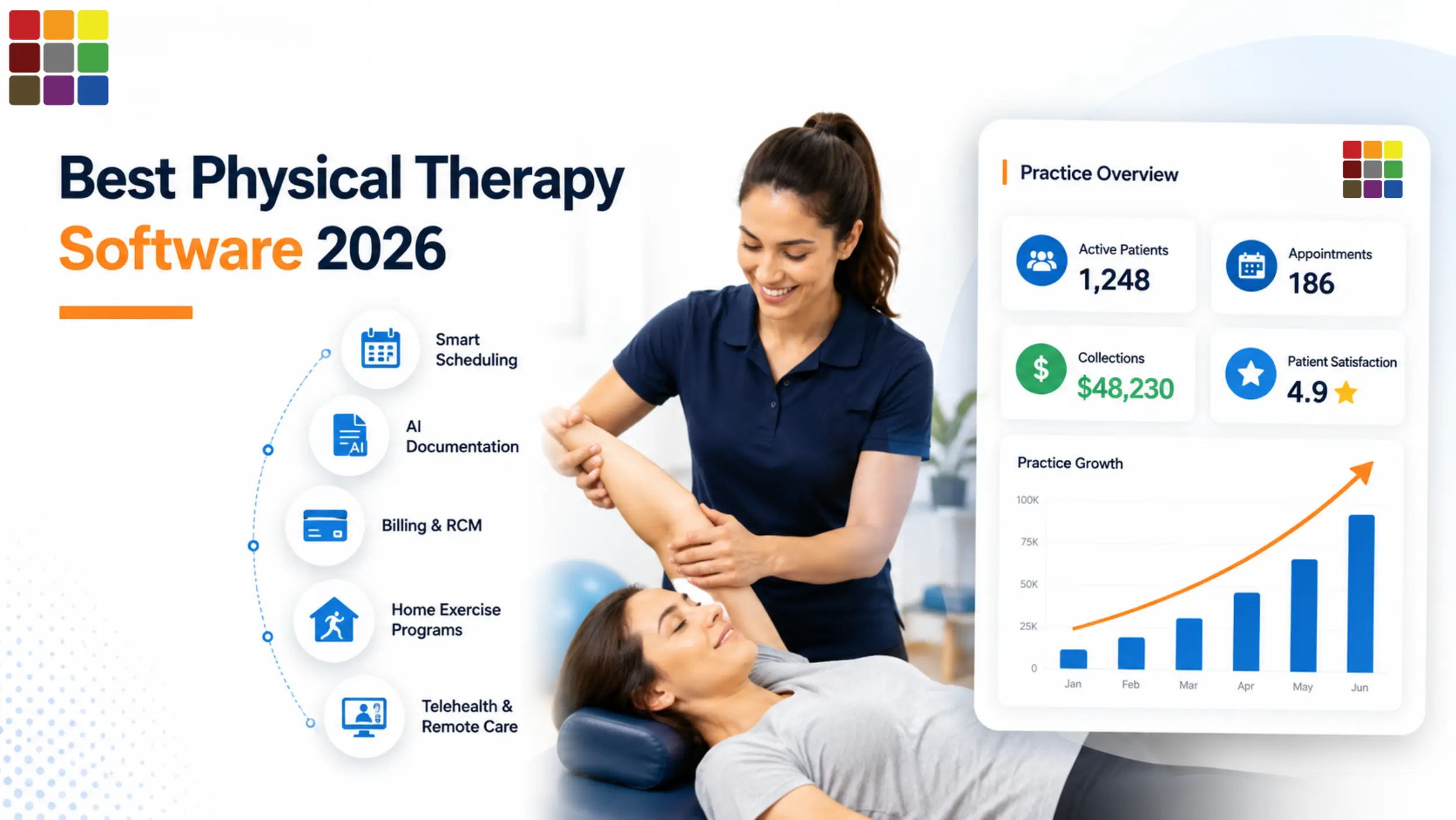
Choosing the right physical therapy software is one of the most consequential decisions a clinic owner makes. The wrong system means double data entry, denied claims, and after-hours charting. The right one runs your entire practice — scheduling, EMR, clinical documentation, billing, and patient engagement — from a single platform. This 2026 buyer's guide breaks down the must-have features, real pricing, and how the leading platforms compare for PT, OT, and SLP clinics.
What Is Physical Therapy Software?
Physical therapy software is an all-in-one platform that helps outpatient rehab clinics manage the full patient journey — scheduling, a physical therapy EMR, clinical documentation, billing, and patient engagement — in one connected system built for PT, OT, and SLP practices.
Instead of stitching together a separate physical therapy EMR, a billing tool, and a scheduler, purpose-built rehab therapy software keeps everything in sync. Information flows automatically from the schedule to the note to the claim — which is exactly why clinics are moving away from generic medical EHRs to rehab-specific physical therapy EHR software designed around how therapists actually work.
Why Choosing PT Software in 2026 Is Different
The biggest change in physical therapy software this year is artificial intelligence. Across the market, AI-assisted documentation has become the single biggest differentiator — because it directly cuts the after-hours charting that fuels clinician burnout. When you evaluate platforms in 2026, AI capabilities should sit near the top of your checklist, right alongside billing and scheduling.
- AI documentation is now table stakes — AI SOAP notes and voice-to-text charting save hours every week
- All-in-one beats bolt-on — clinics want one vendor for EMR, billing, and engagement, not five disconnected tools
- Cloud-based & mobile — access from any location or device is expected, not optional
- Clean claims matter more than ever — tighter 2026 payer rules make integrated billing and RCM essential
- Multi-discipline by default — one platform that serves PT, OT, and SLP under one roof
Bottom line: The best physical therapy software in 2026 pairs a rehab-specific EMR with AI documentation and fully integrated billing — so your team documents faster, gets paid cleaner, and spends more time on patients.
↑ Instead of five disconnected tools, one platform where your data flows automatically.
Software for Every Therapy Discipline: PT, OT & SLP
The best rehab software supports physical therapy, occupational therapy, and speech-language pathology in one system — so multi-discipline clinics document, schedule, and bill for PT, OT, and SLP without switching platforms or forcing one discipline's workflow onto another.
Most therapy practices don't treat just one discipline. A truly modern platform adapts to each — the timed-code workflows a physical therapist needs, the ADL and evaluation-complexity logic an occupational therapist relies on, and the untimed, encounter-based coding that speech-language pathologists live by. Here's how the right software serves each.
Physical Therapy (PT) Software
Physical therapy software and a rehab-specific physical therapy EMR give PTs fast evaluations, timed-code support (the 8-minute rule), and progress notes that hold up to audits — with billing built in so clean claims go out the first time.
Occupational Therapy (OT) Software
Occupational therapy software and a dedicated occupational therapy EMR handle OT evaluation-complexity codes, ADL and self-care documentation, and the GO modifier — so OT practices bill accurately and chart in their own language, not a borrowed PT template.
Speech Therapy (SLP) Software
Speech therapy software and a purpose-built speech therapy EMR support untimed, encounter-based SLP codes, dysphagia and AAC documentation, and the GN modifier — the workflows generic, PT-centric systems often can't configure.
Pediatric Therapy Software
Pediatric therapy software adds what peds clinics need — sensory-integration documentation, caregiver-training workflows, and a pediatric therapy EMR that fits PT, OT, and SLP kids' caseloads in one place.
Running PT, OT, and SLP on a single, rehab-specific platform means one patient record, one schedule, and one billing engine across your whole clinic — the operational edge that generic medical EHRs simply can't match.
Must-Have Features in Physical Therapy Software
Generic medical EHRs rarely fit how therapy clinics work. When comparing physical therapy software, these features separate a purpose-built rehab platform from a generic one. It helps to split them into the clinical tools your therapists use and the business tools your front office and billing team rely on.
Clinical tools
Therapy EMR & AI documentation
Your clinical documentation engine is the heart of the platform: rehab-specific evaluations, SOAP notes, and plans of care, ideally sped up by AI documentation so notes take minutes, not hours.
Business & front-office tools
Scheduling, billing & engagement
The operational side keeps the clinic full and paid: multi-provider scheduling, integrated billing and RCM, and patient engagement that improves retention. The full feature set to look for:
| Feature | What it does | Why it matters |
|---|---|---|
| Therapy EMR / EHR | Rehab-specific charting, evals & SOAP notes | Faster, compliant therapy documentation for PT, OT & SLP |
| AI documentation | AI SOAP notes & voice-to-text charting | Cuts charting time & therapist burnout |
| Scheduling software | Multi-provider appointments & reminders | Fewer no-shows, fuller schedules |
| Patient intake | Digital intake forms & e-signatures | Accurate records, no manual re-entry |
| Insurance verification | Real-time eligibility & benefits checks | Fewer denials before the visit starts |
| Billing & RCM | Therapy billing system & claims management | Higher clean-claim rate, faster payment |
| Referral management | Track & convert incoming referrals | More new patients from your referrers |
| Patient engagement | Engagement tools & patient portal | Better retention & patient experience |
| HEP software | Home exercise programs with video | Better adherence & outcomes |
| Reporting & KPIs | Dashboards for revenue & productivity | Clear visibility into clinic performance |
Physical Therapy EMR vs. EHR vs. Practice Management Software
A physical therapy EHR focuses on the clinical record, documentation, and outcomes. Physical therapy practice management software covers scheduling, billing, and front-office workflows. The best platforms combine both into one system.
In everyday use, "physical therapy EMR software" and "physical therapy EHR software" are used interchangeably — both refer to your electronic medical records for charting evaluations, plans of care, and progress notes. Practice management software adds the business side: appointment scheduling, claims, and reporting. When you buy an all-in-one physical therapy EMR and practice management platform, you get the clinical record and the front office in one place — no module hand-offs, no double entry.
The 2026 differentiator
AI Physical Therapy Software & Documentation
AI physical therapy software uses voice-to-text and automation to draft SOAP notes, pre-fill evaluations, and catch coding errors before claims go out — cutting charting time, burnout, and denials.
Demand for AI clinical documentation has exploded because it solves the #1 pain point in every clinic: documentation burden. A modern AI physical therapy software platform turns a spoken summary into a compliant note in minutes. Look for these AI capabilities:
- AI SOAP notes for PT, OT & SLP drafted from your voice
- AI that pre-fills evaluations from digital intake and documentation
- AI-powered coding & medical-necessity checks that reduce denials
- A therapy AI assistant that fills open schedule slots from a waitlist
Physical Therapy Billing System & Revenue Cycle Management
Even great clinical care doesn't help if claims are denied. A strong physical therapy billing software connects documentation directly to billing, so charges are captured accurately and claims go out clean the first time. That's the difference between therapy medical billing that leaks revenue and a system that protects it.
Integrated revenue cycle management (RCM) automates eligibility verification, scrubs claims for errors, and tracks every dollar from visit to payment. When comparing physical therapy RCM software, prioritize:
- Automated charge capture straight from clinical notes
- Real-time insurance verification & authorization tracking
- Claim scrubbing to catch errors before submission and reduce denials
- Clear accounts-receivable dashboards and payment posting
Patient Engagement, Portal, Home Exercise Programs & Referrals
Great software doesn't stop at the note and the claim. The platforms that grow practices also strengthen the patient relationship and the referral pipeline that feeds new patients in.
Patient engagement & patient portal
Patient engagement software and a self-service patient portal let patients book, complete intake, message your team, and stay on track between visits — which lifts retention and frees up your front desk.
Home exercise programs (HEP)
Built-in home exercise program software with video improves adherence and outcomes, and keeps the plan of care connected to the same record your therapists chart in.
Referral management
Referral management software tracks every incoming referral, shortens time-to-first-visit, and shows your referring providers you convert their patients quickly — turning referral relationships into a reliable growth channel.
Physical Therapy Software Pricing & Cost
Most physical therapy software is priced per provider (or per user) per month. In 2026, published rates commonly range from roughly $75 to $200+ per provider per month depending on modules and clinic size — with billing/RCM sometimes priced as a percentage of collections.
What affects physical therapy software pricing
When you compare physical therapy EMR pricing and total physical therapy software cost, look past the sticker price to the total cost of ownership.
Common pricing models
- Setup & migration fees — some vendors charge for onboarding; others include it
- Billing model — flat fee vs. a percentage of collections for RCM
- Add-on modules — HEP, patient engagement, or analytics may cost extra
Per-provider vs. per-location pricing
Per-provider pricing scales with your clinical team, while per-location or tiered pricing can favor larger, multi-site groups. Match the model to how your practice actually grows.
A note on RCM pricing
Billing/RCM charged as a percentage of collections aligns the vendor's incentive with getting you paid — but model it against your monthly collections so you know the effective cost.
Note: Pricing changes often and varies by clinic. For an accurate quote tailored to your practice, request a demo — most vendors, including Practice Pro, quote based on your provider count and modules.
*General market ranges based on publicly available 2026 vendor information; confirm current pricing directly with each vendor.
Best Physical Therapy Software for Small & Private Practices
You don't need to be a large group to get enterprise-grade tools. The best physical therapy software for small practices gives solo and private clinics the same all-in-one power — a physical therapy EMR for small practice, scheduling, and billing software for small practices — without the complexity or cost of stitching together separate systems.
For a physical therapy software for private practice, prioritize fast onboarding, transparent pricing, and a platform that scales as you add providers, locations, or disciplines. Whether you're searching for the best EMR for a PT practice, an affordable therapy EMR, or multi-discipline software for PT, OT, and SLP, the goal is the same: one connected system that grows with you.
How to Choose the Right Physical Therapy Software
Use this checklist to compare physical therapy software vendors and find the best fit for your clinic:
- Built for rehab — designed for PT, OT & SLP, not a generic medical EHR
- Truly all-in-one — EMR, scheduling, billing & engagement together
- AI documentation — real time savings, not just digital forms
- Multi-discipline — one record across PT, OT, SLP and pediatric therapy
- Cloud-based & mobile — access from any location or device
- HIPAA-compliant — secure, with a clear compliance record
- Transparent pricing & fast onboarding — no surprise fees, quick go-live
- US-based support — a real team behind you after the sale
Why Practice Pro Is the Best Physical Therapy Software for USA Clinics
Practice Pro is AI-powered physical therapy software built specifically for therapy practices across the USA. It brings scheduling, a rehab-specific EMR, clinical documentation, referral management, patient engagement, a patient portal, home exercise programs, and billing together on one cloud-based platform — for PT, OT, SLP, and pediatric therapy clinics alike.
The result is less admin, faster documentation, cleaner claims, and more time for the care that grows your practice. From a single outpatient location to a multi-site rehab group, Practice Pro scales with you — which is exactly why it earns a spot among the best physical therapy EMR and practice management software in 2026.
See it in action: The fastest way to know if Practice Pro is right for your clinic is a quick, no-pressure demo tailored to your workflows. Book yours below 👇